



How Many Cores Does a GYTA Cable Have? A Practical Guide for 2025
author: TTI Fiber
2025-11-13

How Many Cores Does a GYTA Cable Have? A Practical Guide for 2025
When planning outdoor fiber networks—whether for duct installations, aerial deployments, or direct burial—one critical question arises: How many cores does a GYTA cable offer? As a staple loose-tube armored fiber optic cable, GYTA is celebrated for its flexibility in core counts, tailored to everything from small building connections to large-scale backbone networks. This guide breaks down standard core configurations, real-world applications, and key factors to choose the right number.
1. Standard Core Count Range for GYTA Cables
GYTA cables typically range from 2 to 144 cores for most commercial applications, with specialized custom options extending to 288 cores or even 576 cores for high-density projects . The most widely adopted configurations cluster into three practical categories:
1.1 Low Core Counts (2–24 Cores)
These are the go-to for small-scale, point-to-point connections. 2-core and 4-core GYTA cables work perfectly for linking individual buildings, rural broadband access, or small office campus networks. 12-core and 24-core variants shine in residential FTTH (Fiber-to-the-Home) deployments, where each fiber supports multiple households or basic surveillance data streams . Their compact design keeps weight low (as little as 90 kg/km for 2-core) and eases installation in tight ducts .
1.2 Medium Core Counts (36–72 Cores)
The sweet spot for regional and enterprise networks. 36-core and 48-core GYTA cables are favored for urban distribution grids, industrial park connectivity, and interoffice backbones. They balance bandwidth and practicality, supporting concurrent data, voice, and video traffic . 60–72 core options cater to larger campuses or metro area links, where multiple departments or neighborhoods share the network without sacrificing speed.
1.3 High Core Counts (96–144+ Cores)
Built for high-capacity backbone networks and dense urban deployments. 96-core and 144-core GYTA cables power cross-city communication links, data center interconnects, and 5G backhaul networks . Specialized 288-core variants are used for hyperscale projects, while a handful of manufacturers offer custom 576-core designs for extreme-density needs . These high-core cables feature layered loose tubes around a central strength member, maintaining durability despite their higher fiber density .
2. Key Factors That Shape GYTA Core Count Choices
2.1 Cable Structure Limitations
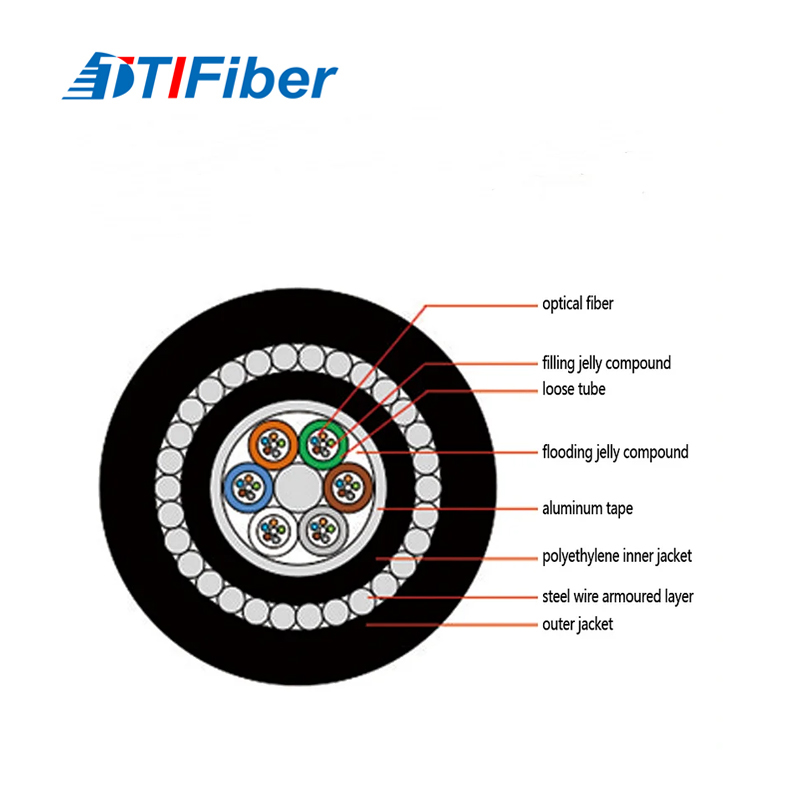
GYTA’s loose-tube stranded design dictates core capacity. Each PBT loose tube typically holds up to 12 fibers, with the number of tubes (plus fillers) determining total cores . Standard designs top out at 12 tubes for 144 cores, while double-layered tube configurations enable 288+ cores . This structure ensures fibers stay protected from stress, even in high-core designs.
2.2 Installation Environment
Direct burial or aerial deployments with long spans (over 100 meters) often use 2–48 core cables to reduce mechanical stress—higher core counts add weight (144-core GYTA weighs ~265 kg/km) and wind/ice load risk . Duct installations, however, can handle high-core cables easily, as the duct supports the weight and shields from environmental strain.
2.3 Bandwidth and Future Scalability
A rural broadband line might only need 2–4 cores for basic 1Gbps speeds, but a 5G macrocell site requires 24–36 cores to handle IoT devices and high-definition streaming . Most network planners add 20–30% extra cores—opting for 48 cores instead of 36, for example—to avoid costly cable replacements as demand grows.
2.4 Industry Standards and Compatibility
GYTA cables adhere to IEC 60794 and YD/T 901 standards, which govern core count increments and performance . While custom core counts are available, sticking to standard increments (12, 24, 48, 72, 144) ensures compatibility with splicing tools and transceivers.
3. Real-World Examples of GYTA Core Count Selection
- Residential FTTH: A mid-sized neighborhood uses 24-core GYTA, with each fiber splitting to 8–16 households via a PLC splitter .
- Industrial Park: A manufacturing complex deploys 48-core GYTA to connect production lines, office buildings, and security systems, with spare cores for future automation upgrades .
- Metro Backbone: A city’s 5G network relies on 144-core GYTA to link 20+ macrocell sites, supporting tens of thousands of concurrent users .
- Rural Broadband: A remote community uses 4-core GYTA for point-to-point access, leveraging the cable’s moisture resistance to withstand harsh weather .
4. Common Myths About GYTA Core Counts
- Myth 1: More cores mean less reliability. Reality: High-core GYTA cables meet the same mechanical standards (1500–3000 N short-term tensile strength) as low-core variants, with aluminum armor ensuring protection .
- Myth 2: Custom core counts are hard to source. Reality: Most manufacturers offer custom core counts (e.g., 18, 60, 84 cores) with minimum orders as low as 1 km .
- Myth 3: GYTA can’t handle high-core direct burial. Reality: 144-core GYTA retains crush resistance (1000 N/100 mm short-term) and moisture protection, making it suitable for direct burial when properly rated .
5. How to Choose the Right GYTA Core Count
- Map current bandwidth needs: Calculate total data from all devices, then add 20–30% for growth.
- Match to installation type: Opt for 2–48 cores for aerial/long-span direct burial; 72+ cores work for duct deployments.
- Check structure compatibility: Ensure your chosen core count aligns with loose-tube design (e.g., 144 cores = 12 tubes × 12 fibers).
- Prioritize standard increments for easier splicing and maintenance.
Conclusion
GYTA cables offer unmatched flexibility in core counts, ranging from 2 to 576+ cores to fit every outdoor network need. The right choice hinges on your project’s scale, installation environment, and future growth plans—not just current demand. Whether you’re connecting a small office or building a city’s 5G backbone, GYTA’s core count versatility, paired with its aluminum armor and moisture resistance, makes it a reliable, long-lasting solution. By balancing practicality and scalability, you’ll select a core count that serves your network today and adapts to tomorrow’s demands.
Founded in 2013, TTI Fiber Communication Tech. Co., Ltd., is a professional manufacturer specializing in Fiber optic products. Our factory located in Shenzhen, China, covers an area of 12,000 square meters and has obtained ISO 9001, ISO 14001, REACH, RoHS, CE and CPR certificates and so on. We have a wide range of fiber optic products, including Fiber Optic Cable, Fiber Optic Patch Cord, Fiber Optic Splitter, Fiber Optic Patch Panel, FTTx products, etc. We also provide professional Fiber Cabling Solutions and one-stop OEM & ODM service. Our main markets are in North America, South America, Europe, Africa and Asia. Our reliable quality and sincere service are highly recognized by our clients all over the world. We cooperated with Global 500 top brands on FTTx products, and more than 30 well-known brand clients in fiber optic industry. Our products are exported to over 100 countries. We are committed to providing our clients with the best support, regardless of their business scale. Our expertise and knowledge of market trends, enables us provide technical support and matched solutions on fiber optic products. We are proud of providing excellent quality, competitive price and timely delivery.
Why choose TTI Fiber
Founded in 2013, TTI Fiber Communication Tech. Co., Ltd., is a professional manufacturer specializing in Fiber optic products. Our factory located in Shenzhen, China, covers an area of 12,000 square meters and has obtained ISO 9001, ISO 14001, REACH, RoHS, CE and CPR certificates and so on. We have a wide range of fiber optic products, including Fiber Optic Cable, Fiber Optic Patch Cord, Fiber Optic Splitter, Fiber Optic Patch Panel, FTTx products, etc. We also provide professional Fiber Cabling Solutions and one-stop OEM & ODM service. Our main markets are in North America, South America, Europe, Africa and Asia. Our reliable quality and sincere service are highly recognized by our clients all over the world. We cooperated with Global 500 top brands on FTTx products, and more than 30 well-known brand clients in fiber optic industry. Our products are exported to over 100 countries. We are committed to providing our clients with the best support, regardless of their business scale. Our expertise and knowledge of market trends, enables us provide technical support and matched solutions on fiber optic products. We are proud of providing excellent quality, competitive price and timely delivery.
GYTA33 Cable: The Ultra-Rugged Solution for Harsh Burial Environments
Difference Between Signal Attenuation and Disruption
Related Article
The steel used in SWA cables is not high-carbon tool steel, nor is it brittle cast iron. It is specifically low-carbon (mild) steel wire, typically containing less than 0.25% carbon.
What Kind of Steel Is Used in the SWA Layer

So what exactly does “correct” installation entail? Where do standards draw the line between best practice and code compliance? And why is grounding not just an electrical formality—but a foundational requirement for safety, reliability, and longevity?
What Do Electrical Codes Specifically Require for SWA Grounding
In a market where “SWA” can be loosely applied to substandard products, how do you ensure the cable you’re purchasing will truly perform as expected over its 25+ year design life? Verification isn’t optional—it’s essential. And it must happen before the cable leaves the factory, not after it fails in the field.
How Do You Verify the Quality of SWA Fiber Optic Cable
