What Is the Working Principle of an SWA Fiber Optic Cable
What Is the Working Principle of an SWA Fiber Optic Cable?
At first glance, an SWA (Steel Wire Armoured) fiber optic cable appears to be a paradox: a strand of ultra-pure glass—so fragile it can be snapped by hand—encased in a sheath of galvanized steel wires thick enough to resist shovels, rodents, and crushing soil pressure. How can such opposites coexist? And more importantly, how does this hybrid structure actually function as a unified system to deliver light across hostile environments without failure?
The answer lies not in brute force alone, but in a layered philosophy of protection, isolation, and signal integrity. SWA cable doesn’t just “armor” fiber—it creates a controlled micro-environment where delicate optics are shielded from the macro-world’s chaos. Let’s explore the true working principle of SWA fiber optic cable: not as a list of parts, but as an integrated engineering strategy.
How Does SWA Cable Protect Fragile Glass Fibers Without Compromising Optical Performance?
The core working principle is mechanical decoupling. The optical fibers inside an SWA cable never bear load, never touch metal, and never experience strain—even when the outer armor is bent, crushed, or stretched.
This is achieved through a multi-layer isolation system:
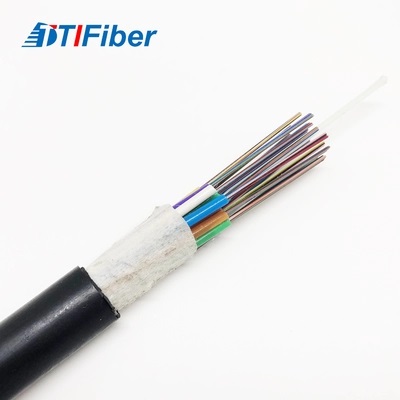
- Loose Buffer Tubes: Fibers float freely in gel-filled or dry water-blocked PBT tubes, allowing them to move independently of the cable’s outer structure. When the cable bends or stretches, the fibers remain slack—never under tension.
- Central Strength Member: A rigid FRP (fiberglass-reinforced plastic) or steel rod absorbs longitudinal forces during installation, preventing buckling or compression of the fiber core.
- Moisture Barrier (APL Sheath): An aluminum-polyethylene laminate blocks water vapor diffusion, ensuring humidity never reaches the fibers—even if the outer sheath is breached.
- Bedding Layer: A soft PVC or PE cushion between the moisture barrier and steel wires prevents abrasion and distributes point loads from the armor.
In essence, the steel wires handle external threats, while the internal layers ensure the fibers experience only stable, stress-free conditions. Light propagation remains undisturbed because the glass never “feels” the outside world.
Why Use Steel Wires Instead of Simpler Armor Like Corrugated Tape?
Because the working principle of SWA isn’t just about resisting pressure—it’s about withstanding dynamic, multi-axis threats.
- Corrugated Steel Tape (CST) resists uniform crush well but can split under point impact (e.g., a rock or shovel edge).
- Steel Wire Armor (SWA), by contrast, uses helically wound round wires that:
- Distribute localized impacts across multiple wires.
- Resist penetration from teeth, claws, or sharp tools.
- Provide high tensile strength for direct burial in unstable soil or long aerial spans (when lashed).
- Maintain flexibility despite extreme ruggedness.
The helical wire design acts like chainmail—rigid yet conformable. This makes SWA uniquely suited for unpredictable mechanical environments where threats aren’t just vertical loads, but lateral cuts, torsion, and vibration.
How Does SWA Prevent Signal Degradation from Environmental Stressors?
Beyond physical damage, environmental factors like moisture, temperature swings, and hydrogen can degrade optical performance over time. SWA addresses these through passive, material-based defense:
- Water Ingress: Blocked by dual mechanisms—water-swellable tapes/SAP powders absorb moisture, while the APL sheath stops vapor diffusion. Even if the PVC sheath cracks, water migration is limited to <1 meter (per IEC 60794).
- Thermal Cycling: The loose-tube design accommodates differential expansion between steel (low CTE) and fiber (moderate CTE). Fibers remain strain-free from −40°C to +70°C.
- Hydrogen Aging: Premium G.652.D fibers with hermetic coatings resist hydrogen darkening—a critical feature in buried cables where anaerobic corrosion can generate H₂ gas over decades.
Thus, the working principle extends beyond installation survival to 30+ years of optical stability.
Doesn’t the Conductive Steel Armor Risk Interference or Safety Hazards?
It does—which is why the working principle includes electrical management as a core tenet.
Unlike all-dielectric cables (e.g., ADSS), SWA’s steel armor is electrically conductive. This introduces two risks:
- Induced voltages from nearby power lines.
- Lightning surge conduction to termination points.
To mitigate this, SWA cable must be grounded at both ends per electrical codes (NEC Article 770, IEC 62305). This:
- Drains induced currents safely to earth.
- Prevents voltage buildup that could arc to equipment.
- Avoids creating an antenna for electromagnetic energy.
Crucially, the optical signal itself remains immune—light doesn’t care about grounding. But the safety of personnel and electronics depends on proper bonding. Thus, the working principle integrates optical purity with electrical responsibility.
How Does SWA Enable Direct Burial Without Conduit—And Why Does That Matter?
The entire rationale for SWA hinges on self-sufficiency. In traditional deployments, fiber runs inside PVC or HDPE conduit for protection. But conduit adds cost, labor, and future maintenance complexity (e.g., difficulty pulling replacement cables).
SWA eliminates this need by embedding conduit-level protection into the cable itself. Its steel wires:
- Resist soil pressure and rock impingement.
- Deter excavation damage (visible metallic layer warns diggers).
- Survive rodent attack far better than tape-armored alternatives.
This “conduit-in-one” approach reduces total project cost by 20–40% in greenfield deployments and accelerates installation—especially in rural or rugged terrain. The working principle, therefore, is not just technical—it’s economic and logistical.
What Role Does the Outer Sheath Play in the Overall Function?
The black PVC (or LSZH/PE) outer sheath is more than cosmetic—it’s the first line of environmental defense:
- UV Stabilization: Carbon-black-loaded PVC resists solar degradation for >25 years above ground.
- Abrasion Resistance: Protects steel wires from wear during pulling or soil friction.
- Chemical Resistance: Withstands oils, mild acids, and alkalis in industrial soils.
- Fire Performance: PVC self-extinguishes; LSZH variants produce low smoke/toxicity for indoor transitions.
Without this sheath, the steel wires would corrode prematurely, compromising long-term armor integrity. Thus, the sheath isn’t passive—it’s active preservation.
Is the Working Principle Just About Survival—or Something Deeper?
The true working principle of SWA fiber optic cable is trust through layered redundancy. It assumes that any single layer might fail—but the system as a whole will not. Water may breach the sheath, but the APL barrier holds. Rocks may dent the armor, but the loose tubes protect the fibers. Lightning may strike, but grounding saves the endpoint.
This philosophy mirrors the best of engineering: not relying on perfection, but designing for resilience. SWA doesn’t promise invincibility—it promises graceful endurance.
And in a world where connectivity is critical infrastructure, that’s not just clever design. It’s quiet assurance, wrapped in steel, carrying light through the storm.


How Do You Verify the Quality of SWA Fiber Optic Cable
What Is the Raw Material of an SWA Fiber Optic Cable
Related Article