What Does “GYTA” Stand For
Table of Contents
What Is GYTA Fiber Optic Cable—and Why Does It Matter in Real-World Networks?
If you’ve worked with outdoor fiber infrastructure—whether for telecom backbones, utility networks, or enterprise campus links—you’ve likely encountered a cable labeled GYTA. It’s one of the most widely deployed outdoor fiber optic cable types across Asia, Europe, and emerging markets. But what does “GYTA” actually mean? And more importantly, why is this specific construction chosen over others for demanding environments?
The answer lies not just in its structure, but in how it balances protection, cost, scalability, and longevity—all while surviving decades buried underground or lashed to poles in harsh climates.
What Does “GYTA” Stand For—And What Does Each Letter Reveal?
GYTA is a standardized naming convention defined by Chinese national standards (GB/T), widely adopted in international projects. Each letter encodes a key design feature:
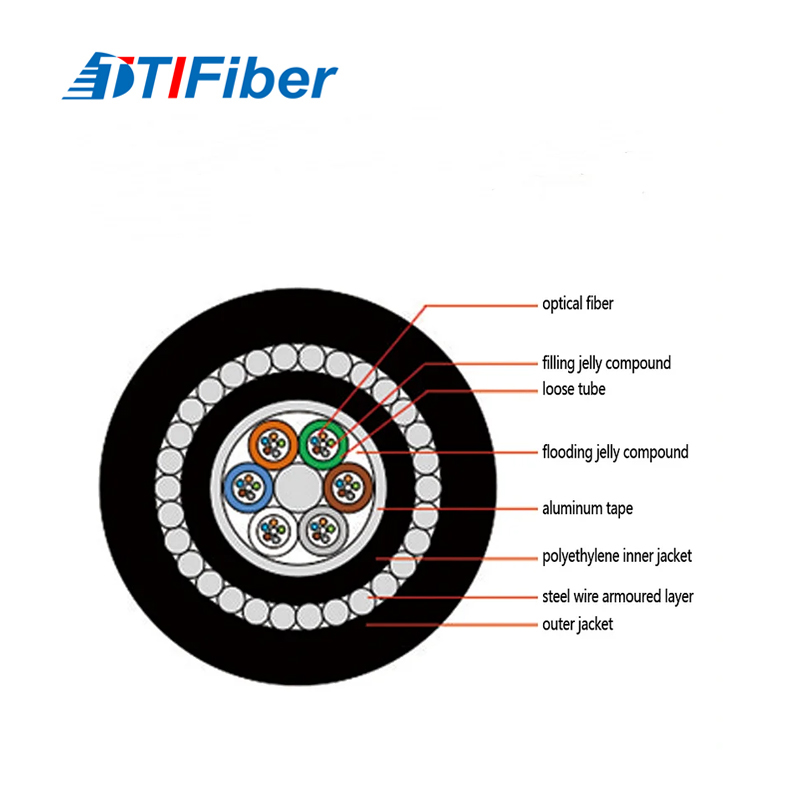
Put simply: GYTA is a loose-tube, outdoor fiber optic cable with a central strength member, gel-filled buffer tubes, and a metallic moisture barrier wrapped in a polyethylene jacket.
This isn’t just jargon—it’s a carefully engineered response to the biggest threats facing buried or aerial fiber: water, rodents, crushing forces, and long-term environmental stress.
How Is GYTA Constructed—And Why Does That Design Work?
Peel back the layers of a GYTA cable, and you’ll find a classic “defense-in-depth” approach:
This layered architecture makes GYTA ideal for direct burial, duct installation, or aerial lashing—especially in regions with high humidity, heavy rainfall, or aggressive wildlife.
How Does GYTA Compare to Other Common Cable Types—Like GYTS or GYFTA?
Not all outdoor cables are the same. Small changes in construction lead to big differences in performance and use case:
Critical distinction: GYTA contains metal (aluminum tape), so it must be properly grounded at both ends when used aerially or near power lines. Failure to do so can lead to dangerous voltage induction during lightning strikes or power faults.
Meanwhile, GYTS—with its steel tape—offers superior crush resistance but is heavier and harder to handle. GYTA strikes a balance: lighter than GYTS, more protective than all-dielectric designs, and significantly cheaper than armored alternatives.
Where Is GYTA Most Commonly Used—and Why?
GYTA dominates in three key scenarios:
It’s less suited for:
What Are the Key Specifications Engineers Should Verify?
When specifying or accepting GYTA cable, don’t just trust the label. Confirm these critical parameters:
Pro tip: Always request a cable construction drawing and certification test reports—not just a datasheet. Field failures often trace back to undocumented substitutions (e.g., thinner aluminum tape or reduced gel fill).
Are There Common Pitfalls or Misconceptions About GYTA?
Yes—three in particular:
What’s the Bigger Picture? Why Does GYTA Endure?
GYTA isn’t flashy. It doesn’t use hollow-core fiber or bend-insensitive glass. But it embodies a fundamental engineering truth: the best infrastructure is the one that disappears—working reliably for 25+ years without maintenance.
Its genius lies in pragmatic robustness: enough protection to survive real-world abuse, simple enough to manufacture at scale, and affordable enough to deploy across entire nations. From village backhaul links in Southeast Asia to metro rings in Eastern Europe, GYTA is the quiet workhorse of global connectivity.
And in an age of hype around terabit speeds and quantum networks, that reliability—layer after layer, fiber after fiber—is not just valuable. It’s essential.
Is GYTA “Just a Cable”—Or Something More?
To an outsider, GYTA might seem like a commodity: black, stiff, and unremarkable. But to the engineer who’s seen it survive monsoons, frost heaves, and decades of thermal cycling, it represents something deeper.
It’s a physical covenant—between designers who anticipated failure modes, manufacturers who held tolerances, installers who handled it with care, and communities that depend on the light it carries.
So the next time you see a GYTA cable coiled in a trench or lashed to a pole, remember: it’s not just conduit. It’s continuity, wrapped in polyethylene and sealed against time.
GYXY Core Count: Selection Guide & Technical Specifications
GYXY Cable: Core Selection, Specs & Applications Guide
Related Article