



Everything About Optical Fiber with MPO Connectors
author: TTI Fiber
2024-12-10
IWhether it’s for a data center, telecommunications network, or enterprise system, efficient data transmission is essential. Optical fiber, known for its ability to transmit data over long distances without signal loss, plays a crucial role in meeting these demands. But when it comes to managing multiple fiber connections at once, optical fiber alone isn’t enough. This is where MPO (Multi-fiber Push-On) connectors come in.
If you're working on upgrading your network or building a new one, understanding optical fiber with MPO connectors is key to making the right decisions. Next TTI Fiber will take a closer look at these connectors, their construction, materials, and how they work with optical fiber to deliver superior performance in high-density environments.

What is Optical Fiber?
At its core, optical fiber is a glass or plastic thread that’s designed to carry light signals, enabling the high-speed transmission of data. Unlike traditional copper cables that use electrical signals, optical fiber uses light, allowing it to transmit information faster and over much longer distances with minimal signal loss.
There are two primary types of optical fiber:
- Single-Mode Fiber (SMF): This type is designed for long-distance communication. It has a small core (about the size of a human hair) that allows light to travel in a single path, reducing loss and interference.
- Multi-Mode Fiber (MMF): MMF, on the other hand, has a larger core and is designed for shorter distances, typically within buildings or local networks.
- Single-Mode Fiber (SMF): This type is designed for long-distance communication. It has a small core (about the size of a human hair) that allows light to travel in a single path, reducing loss and interference.
- Multi-Mode Fiber (MMF): MMF, on the other hand, has a larger core and is designed for shorter distances, typically within buildings or local networks.
The choice between these two types depends on factors like distance and bandwidth requirements, but both offer excellent performance compared to traditional copper wiring.
What is an MPO Connector?
The MPO connector (Multi-fiber Push-On) is a high-density fiber optic connector used for high-speed data transmission. Unlike traditional single-fiber connectors that handle one fiber at a time, an MPO connector can support multiple fibers—typically 12, 24, or even 48 fibers in one single unit.
MPO connectors are a go-to solution for networks that need to handle high traffic with minimal space. Whether you’re setting up a data center or installing fiber in a telecom backbone, MPO connectors help you save time, space, and effort.
Some important features of MPO connectors include:
- Push-On/Pull-Off Mechanism: MPO connectors are designed for quick and easy installation with a simple push-on, pull-off design, meaning you don’t need any special tools or skills.
- MTP vs. MPO: While the MPO connector is widely used, the MTP (Mechanical Transfer Push-On) connector is a more advanced version that offers improved performance, especially for high-density, high-speed applications.
- Push-On/Pull-Off Mechanism: MPO connectors are designed for quick and easy installation with a simple push-on, pull-off design, meaning you don’t need any special tools or skills.
- MTP vs. MPO: While the MPO connector is widely used, the MTP (Mechanical Transfer Push-On) connector is a more advanced version that offers improved performance, especially for high-density, high-speed applications.
How Optical Fiber Works with MPO Connectors?
The true magic happens when optical fiber and MPO connectors come together. Optical fibers are aligned inside the MPO connector in a precise way to ensure that the light signals pass seamlessly through the fibers. Each fiber in the MPO connector is meticulously connected to ensure high-quality transmission with minimal loss or distortion.
MPO connectors are most often used in pre-terminated fiber assemblies—preassembled cables with MPO connectors already installed on both ends. This saves time and minimizes the complexity of installation, which is especially helpful in environments like data centers where space and efficiency are paramount.
In high-density environments, where space is at a premium, MPO connectors provide a solution to bundle multiple fibers into a single connector. This means that a single MPO cable can carry a dozen or more fibers, reducing the bulk of individual fiber cables and making cable management far more efficient.
Any Benefits of Using Optical Fiber with MPO Connectors?
1. Space Efficiency: One of the biggest benefits of using MPO connectors with optical fiber is the high density they offer. Since an MPO connector can carry multiple fibers in a single connector, you can reduce the amount of space taken up by cables. This is especially important in environments like data centers, where every inch counts.
2. Cost-Effective: The simplicity of MPO connectors makes them cost-effective for large-scale installations. Since they reduce the number of individual fiber connections needed, you’ll save on materials, labor, and time.
3. High-Speed Data Transmission: MPO connectors are capable of supporting high-bandwidth applications, including 10G, 40G, and 100G Ethernet. With optical fiber’s ability to handle massive amounts of data at high speeds, MPO connectors are ideal for supporting modern data networks and telecom infrastructure.
4. Scalability and Flexibility: MPO connectors are designed with the future in mind. As your network grows, you can easily add more fiber capacity by simply adding more MPO connectors, making it easier to scale your network without disrupting existing systems.
5. Simplified Maintenance: MPO connectors eliminate the need for individual fiber splicing, which can be time-consuming and error-prone. Troubleshooting is also simplified because you can quickly identify and replace a faulty cable or connector without disrupting the entire network.
What’s the Applications of Optical Fiber with MPO Connectors?
The versatility of optical fiber with MPO connectors makes them an ideal solution for several high-performance network applications:
- Data Centers: MPO connectors help manage high-density fiber connections in data centers, providing the bandwidth needed for cloud services, big data, and high-performance computing.
- Telecommunications Networks: MPO connectors are commonly used in the backbone infrastructure of telecom networks, enabling fast and reliable data transmission between remote locations.
- Enterprise Networks: In large enterprise environments, optical fiber with MPO connectors ensures seamless connectivity between offices, data centers, and the cloud.
- 5G Networks: With the rollout of 5G, high-speed fiber optic connections will be essential for the network infrastructure. MPO connectors will play a major role in facilitating the large bandwidth needed for 5G services.
- High-Performance Computing (HPC): Optical fiber with MPO connectors is crucial for linking computing clusters and supercomputers that require ultra-fast data transfer rates.
- Telecommunications Networks: MPO connectors are commonly used in the backbone infrastructure of telecom networks, enabling fast and reliable data transmission between remote locations.
- Enterprise Networks: In large enterprise environments, optical fiber with MPO connectors ensures seamless connectivity between offices, data centers, and the cloud.
- 5G Networks: With the rollout of 5G, high-speed fiber optic connections will be essential for the network infrastructure. MPO connectors will play a major role in facilitating the large bandwidth needed for 5G services.
- High-Performance Computing (HPC): Optical fiber with MPO connectors is crucial for linking computing clusters and supercomputers that require ultra-fast data transfer rates.
How to Choose Optical Fiber with MPO Connectors?
Selecting the right optical fiber with MPO connectors depends on several factors:
- Type of Fiber: If you need long-distance connectivity, single-mode fiber with MPO connectors will be the right choice. For shorter distances, multi-mode fiber is more cost-effective.
- Fiber Count: MPO connectors typically come in 12, 24, or 48 fibers. Choose the fiber count based on your network’s current and future capacity needs.
- Connector Gender: MPO connectors come in male and female versions. Be sure to match the gender of the connector to the device you are connecting to.
- Type of Fiber: If you need long-distance connectivity, single-mode fiber with MPO connectors will be the right choice. For shorter distances, multi-mode fiber is more cost-effective.
- Fiber Count: MPO connectors typically come in 12, 24, or 48 fibers. Choose the fiber count based on your network’s current and future capacity needs.
- Connector Gender: MPO connectors come in male and female versions. Be sure to match the gender of the connector to the device you are connecting to.
The Construction of Optical Fiber with MPO Connectors?
Optical fiber with MPO connectors is a carefully engineered system. The fiber construction itself consists of a core, cladding, and protective jacket. The core carries the light signal, while the cladding keeps the light within the core by reflecting it back, ensuring it travels efficiently over long distances.
MPO connectors are designed to hold multiple fibers in alignment with precision. The construction of an MPO connector involves a housing that holds individual fibers in place with high accuracy, ensuring the fibers align properly for optimal signal transmission.
The Material of Optical Fiber with MPO Connectors?
The materials used in optical fiber with MPO connectors are chosen for their performance, durability, and ability to withstand environmental factors:
- Optical Fiber Material: The core of most optical fibers is made from silica glass due to its transparency and low attenuation, which allows light to travel with minimal loss.
- MPO Connector Material: MPO connectors are typically made from high-grade plastics (such as polycarbonate or thermoplastic) for the housing, along with metal alloys (such as stainless steel) for the pins and locking mechanisms, ensuring reliability and durability in various environments.
- Optical Fiber Material: The core of most optical fibers is made from silica glass due to its transparency and low attenuation, which allows light to travel with minimal loss.
- MPO Connector Material: MPO connectors are typically made from high-grade plastics (such as polycarbonate or thermoplastic) for the housing, along with metal alloys (such as stainless steel) for the pins and locking mechanisms, ensuring reliability and durability in various environments.
These materials help the connectors endure wear and tear while maintaining high performance over time.
Optical fiber with MPO connectors is the backbone of modern high-speed, high-density networks. By combining the efficiency of optical fiber with the flexibility and scalability of MPO connectors, businesses can build networks that meet today’s data demands while remaining future-proof.
Whether you’re setting up a new data center, upgrading your telecom network, or enhancing your enterprise infrastructure, optical fiber with MPO connectors provides the speed, capacity, and space efficiency needed to keep your systems running smoothly.
As network demands continue to grow, understanding and utilizing optical fiber with MPO connectors will be an essential part of building efficient, high-performance networks that are ready for the future.
TTI Fiber Communication Tech. Co., Ltd., is a professional manufacturer specialized in Fiber optic products for 13 years. Our factory located in Shenzhen, China, covers an area of 12,000 square meters and has obtained ISO9001, ISO14001, REACH, RoHS, CE and CPR certificates and so on. We have a wide range of fiber optic products, including Fiber Optic Cable, Fiber Optic Patch Cord, Fiber Optic Splitter, Fiber Optic Patch Panel, FTTx products, etc. We also provide professional Fiber Cabling Solutions and one-stop OEM & ODM service.
Optical Fiber with MPO Connectors Construction
What is FTTH Technology?
Related Article
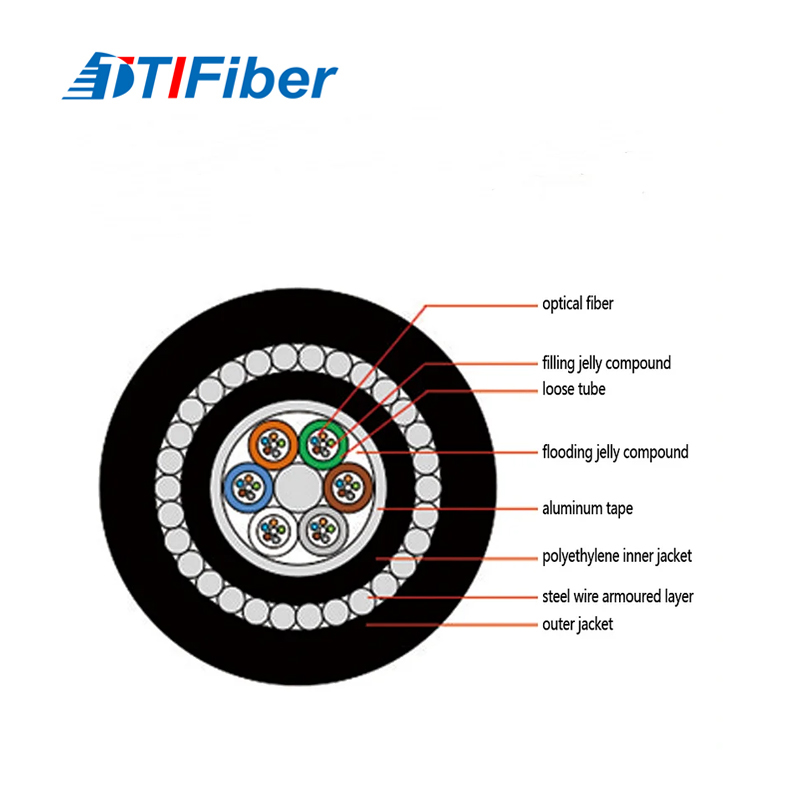
The steel used in SWA cables is not high-carbon tool steel, nor is it brittle cast iron. It is specifically low-carbon (mild) steel wire, typically containing less than 0.25% carbon.
What Kind of Steel Is Used in the SWA Layer

So what exactly does “correct” installation entail? Where do standards draw the line between best practice and code compliance? And why is grounding not just an electrical formality—but a foundational requirement for safety, reliability, and longevity?
What Do Electrical Codes Specifically Require for SWA Grounding
In a market where “SWA” can be loosely applied to substandard products, how do you ensure the cable you’re purchasing will truly perform as expected over its 25+ year design life? Verification isn’t optional—it’s essential. And it must happen before the cable leaves the factory, not after it fails in the field.
How Do You Verify the Quality of SWA Fiber Optic Cable
