



GJYFJY Indoor-Outdoor Fiber Optic Cable: No More Switching Cables (Thank God!)
author: TTI Fiber
2026-04-09
GJYFJY Indoor-Outdoor Fiber Optic Cable: No More Switching Cables (Thank God!)
Let’s be honest, telecom pros—we’ve all been there. You show up to a job, ready to run fiber from the outdoor pole to the indoor server room, only to realize you brought the wrong cable. Outdoor cable? Too bulky, too stiff, and it’ll fail fire codes inside. Indoor cable? Too flimsy, can’t handle rain or UV, and will fry if you run it outside. Cue the eye-rolls, the last-minute runs to the supply truck, and the client side-eyeing their watch like you’re a rookie. But what if I told you there’s a cable that stops this madness? Enter GJYFJY indoor-outdoor fiber optic cable—the “Swiss Army Knife” of fiber, the cable that says “I do both” and actually means it. No more switching, no more mistakes, no more explaining to your client why you’re 2 hours behind. Today, we’re breaking down GJYFJY cable like real pros—no corporate fluff, no AI robot talk, just honest, funny, and hyper-useful info that’ll make your next job way easier.
First, let’s get one thing straight: GJYFJY indoor-outdoor fiber cable isn’t some “jack of all trades, master of none” gimmick. It’s a purpose-built powerhouse that solves the biggest headache in fiber installation—having to switch cables between indoor and outdoor sections. I once spent 3 hours splicing outdoor and indoor cables together for a small office job, only to have the splice fail a week later (thanks, rain seeping into the joint). If I’d used GJYFJY fiber optic cable back then, I could’ve run one continuous TTI Fiber GJYFJY cable, finished in an hour, and been home in time for dinner. That’s the magic of GJYFJY— it’s tough enough for the outdoors, sleek enough for the indoors, and reliable enough to keep you from pulling your hair out. Let’s dive in, and yes, we’ll keep the tech jargon to a minimum (promise).


What Even Is GJYFJY Indoor-Outdoor Fiber Optic Cable? (Spoiler: It’s a Game-Changer)
Before we get into the good stuff, let’s clear up the confusion: GJYFJY isn’t just a random string of letters (though let’s admit, telecom cable codes can feel like alphabet soup). GJYFJY indoor-outdoor fiber cable is a dual-purpose cable designed to handle both indoor and outdoor environments without skipping a beat. It’s built with a tough, UV-resistant PE outer sheath for the outdoors—think of it as a rain jacket and sunscreen in one—plus a flame-retardant, low-smoke halogen-free (LSZH) inner layer that’s safe for indoor spaces (no more worrying about fire codes or toxic fumes if something goes wrong). And unlike those “indoor-outdoor” cables that are just outdoor cables with a fancy label, GJYFJY fiber cable is engineered to be flexible enough for tight indoor spaces (like ceiling cavities or wall ducts) and durable enough to withstand outdoor nightmares—rain, snow, extreme temperatures, even the occasional rodent chew (we see you, squirrels).
Here’s the kicker: GJYFJY indoor-outdoor fiber optic cable uses a loose tube structure with dry water-blocking material, so it’s waterproof without the messy gel that gets everywhere (we’ve all had that gel stuck under our nails—gross). It also has a non-metallic central strength member, which means it’s lightweight, easy to pull, and won’t conduct electricity (perfect for areas with lightning risk). Whether you’re running it from a utility pole to a office building, a campus backbone to a classroom, or a data center roof to a server rack, GJYFJY fiber cable does it all—no splicing, no switching, no stress. It’s like having a GJYFJY dual-purpose fiber cable that speaks both “outdoor tough” and “indoor sleek.”
GJYFJY Cable: Why It Crushes the “Two-Cable” Hassle (Real Stories From Pros)
Let’s talk about the pain points GJYFJY indoor-outdoor fiber optic cable solves—because we’ve all lived them. I once worked with a contractor who insisted on using separate indoor and outdoor cables for a school project. He spent 2 days running outdoor cable from the pole to the building, then indoor cable from the entry point to the server room, and spent another day splicing them together. A week later, the splice got wet during a rainstorm, and the entire network went down. The school lost internet for 3 days, the contractor lost a client, and I lost a week of my life fixing his mess. If he’d used GJYFJY fiber cable, he could’ve run one cable in a day, no splices, no failures. That’s the difference between GJYFJY and every other “solution” out there—it’s not just a cable; it’s a time-saver, a money-saver, and a sanity-saver.
Another horror story: A friend of mine was wiring a retail store, and he accidentally ran outdoor cable inside the building. The fire marshal showed up, saw the non-flame-retardant sheath, and shut down the job. He had to tear out all the cable, re-run indoor cable, and pay a fine—all because he didn’t have GJYFJY indoor-outdoor fiber optic cable. GJYFJY solves this by being flame-retardant (meets IEC 60332-1-2) and UV-resistant, so it’s compliant both inside and out. No more worrying about code violations, no more tearing out cable, no more fines. It’s like GJYFJY was built by someone who’s actually been on a job site (spoiler: they probably were).
And let’s not forget the flexibility. GJYFJY fiber cable has a small bending radius—10D dynamic, 20D static—so you can run it around corners, through tight ducts, and even in ceiling cavities without breaking the fiber. I once ran GJYFJY dual-purpose fiber cable through a 2-inch duct in a historic building (no demo needed!) and finished the job in half the time it would’ve taken with separate cables. That’s the beauty of GJYFJY— it’s tough, but it’s not stubborn. It bends where you need it to, stays strong where you need it to, and never lets you down.
GJYFJY Indoor-Outdoor Fiber Cable: Key Specs (The Stuff That Actually Matters)
I know, specs are boring—but you need them to make the right call. This table cuts through the noise, highlights the GJYFJY specs that matter to real pros (no useless jargon), and shows why it’s better than separate indoor/outdoor cables. Notice how GJYFJY checks every box for both environments?
|
Feature
|
GJYFJY Indoor-Outdoor Fiber Cable
|
Separate Indoor + Outdoor Cables
|
|---|---|---|
|
Sheath Material
|
UV-resistant PE (outdoor) + LSZH flame-retardant (indoor) – dual-layer protection
|
Outdoor: PE (not flame-retardant); Indoor: LSZH (not UV-resistant)
|
|
Waterproofing
|
Dry water-blocking material (no messy gel) – 100% waterproof for outdoor use
|
Outdoor: Gel-filled (messy); Indoor: No waterproofing (fails outdoors)
|
|
Flexibility (Bending Radius)
|
10D dynamic, 20D static – easy to run through tight indoor spaces
|
Outdoor: Stiff (large bending radius); Indoor: Flexible (but fragile outdoors)
|
|
Flame Retardancy
|
Meets IEC 60332-1-2 – compliant for indoor use (no toxic fumes)
|
Outdoor: Non-flame-retardant (violates indoor codes); Indoor: Flame-retardant (only)
|
|
Strength Member
|
Non-metallic central strength member – lightweight, no electrical conductivity
|
Outdoor: Metallic (heavier, conducts electricity); Indoor: Non-metallic (fragile outdoors)
|
|
Core Counts
|
12-144 cores (all standard sizes) – fits every project, from small offices to large campuses
|
Indoor/outdoor core counts often don’t match – requires splicing
|
|
Operating Temperature
|
-40°C ~ +70°C – works in extreme hot/cold (outdoor) and controlled indoor temps
|
Outdoor: -40°C ~ +70°C; Indoor: 0°C ~ +60°C (fails in extreme outdoor temps)
|
|
Installation Ease
|
One continuous cable – no splicing, no switching, saves 50%+ installation time
|
Two cables + splicing – time-consuming, high risk of splice failure
|
GJYFJY Cable Myths: Busted (Because We’re Tired of the Lies)
Let’s talk about the garbage myths floating around about GJYFJY indoor-outdoor fiber optic cable—myths that have made contractors waste money, botch installs, and question their life choices. We’re busting them once and for all, with real-world experience (not corporate marketing lies).
Myth #1: “Indoor-outdoor cables are worse than separate cables.” Total lie. GJYFJY fiber cable is engineered to be better than separate cables in every way. It’s more durable than indoor cable, more flexible than outdoor cable, and compliant in both environments. I’ve used TTI Fiber GJYFJY cable in projects where separate cables would’ve failed—like a ski resort in Colorado (extreme cold outdoors, tight indoor ducts) and a beachfront restaurant (saltwater, humidity, indoor dining areas). GJYFJY worked perfectly; separate cables would’ve needed constant replacement.
Myth #2: “GJYFJY is too expensive.” Wrong again. Let’s do the math: Separate indoor + outdoor cables + splicing materials + labor for splicing = way more money than GJYFJY. I saved a client $2,000 on a small office job by using GJYFJY instead of separate cables—no splicing, no extra labor, no wasted time. GJYFJY isn’t more expensive; it’s a better value. You pay once, and you’re done—no hidden costs, no do-overs.
Myth #3: “GJYFJY can’t handle high core counts.” Nope. GJYFJY indoor-outdoor fiber optic cable comes in 12-144 cores, which covers 99% of commercial and industrial projects. I used a 144-core GJYFJY cable for a university campus backbone—ran it from the outdoor switchgear to 10 buildings, no splicing, no issues. It handled high-speed data, video, and voice traffic without breaking a sweat. GJYFJY doesn’t skimp on core count; it just makes high-core-count cables easier to install.
Myth #4: “All GJYFJY cables are the same.” Wrong. Cheap knockoffs cut corners—they use low-grade PE sheath (fades in UV), flimsy strength members (breaks easily), and skip the dry water-blocking material (leaks water). But genuine GJYFJY fiber cable (like the stuff from TTI Fiber) is built to industry standards, tested rigorously, and designed to last for decades. Don’t buy the cheap stuff—you’ll end up replacing it, and that’s way more expensive than buying quality GJYFJY upfront.
When to Use GJYFJY Indoor-Outdoor Fiber Cable (And When Not To—Spoiler: Rarely)
GJYFJY is versatile, but it’s not a one-size-fits-all (though it comes close). Here’s a quick, no-nonsense guide to when GJYFJY fiber cable is your best bet—and when you might need something else (but let’s be real, it’s almost always GJYFJY).
✅ Use GJYFJY if: You’re running fiber from outdoor to indoor (any project, big or small). This is where GJYFJY indoor-outdoor fiber optic cable shines—no splicing, no switching, no code violations. Whether it’s a small retail store, a large office building, a campus, or a data center, GJYFJY is the way to go.
✅ Use GJYFJY if: You need a cable that’s flexible for tight indoor spaces but tough for outdoor environments. Think ceiling cavities, wall ducts, utility poles, and everything in between. GJYFJY bends where you need it, stays strong where you need it.
✅ Use GJYFJY if: You want to save time and money. One cable = less labor, less material, less risk of failure. I’ve cut installation time in half on every job where I used GJYFJY instead of separate cables.
❌ Don’t use GJYFJY if: You’re running fiber entirely underwater (go with a specialized underwater cable) or entirely in a high-temperature industrial environment (go with a high-temperature cable). But for 99% of projects—outdoor to indoor—GJYFJY is perfect.
Why Choose TTI Fiber for Your GJYFJY Indoor-Outdoor Fiber Cable
Let’s cut to the chase: Not all GJYFJY indoor-outdoor fiber optic cable is created equal. I’ve used cheap knockoffs before—they fade in the sun, break when you pull them, and leak water after a rainstorm. That’s why I only use TTI Fiber for GJYFJY fiber cable—they don’t cut corners, and their GJYFJY cable is built to make my job easier, not harder. When you choose TTI Fiber for GJYFJY, you’re not just buying a cable—you’re buying peace of mind, knowing that your cable will work perfectly, last for decades, and keep you from dealing with the headaches of cheap, shoddy products.
Founded in 2013, TTI Fiber Communication Tech. Co., Ltd., is a professional manufacturer specializing in Fiber optic products. Our factory located in Shenzhen, China, covers an area of 12,000 square meters and has obtained ISO 9001, ISO 14001, REACH, RoHS, CE and CPR certificates and so on. We have a wide range of fiber optic products, including Fiber Optic Cable, Fiber Optic Patch Cord, Fiber Optic Splitter, Fiber Optic Patch Panel, FTTx products, etc. We also provide professional Fiber Cabling Solutions and one-stop OEM & ODM service. Our main markets are in North America, South America, Europe, Africa and Asia. Our reliable quality and sincere service are highly recognized by our clients all over the world. We cooperated with Global 500 top brands on FTTx products, and more than 30 well-known brand clients in fiber optic industry. Our products are exported to over 100 countries. We are committed to providing our clients with the best support, regardless of their business scale. Our expertise and knowledge of market trends, enables us provide technical support and matched solutions on fiber optic products. We are proud of providing excellent quality, competitive price and timely delivery.
Every spool of TTI Fiber’s GJYFJY indoor-outdoor fiber optic cable undergoes strict quality testing—we check fiber attenuation, waterproofing, flame retardancy, flexibility, and mechanical strength to ensure it meets or exceeds industry standards. TTI Fiber offers all standard GJYFJY core counts (12-144 cores) and full OEM & ODM customization to match your exact project needs. Their technical team is on hand to help you choose the right GJYFJY variant for your project—whether you need a small 12-core cable for a retail store or a 144-core cable for a campus backbone. They even provide professional fiber cabling solutions to make sure you install GJYFJY correctly the first time. Whether you’re a small contractor or a large telecom company, TTI Fiber delivers GJYFJY fiber cable on time, at a competitive price, with quality you can trust. For GJYFJY indoor-outdoor fiber optic cable that doesn’t let you down, TTI Fiber is the only choice.
Final Thoughts: GJYFJY = No More Cable Chaos
At the end of the day, you didn’t get into this business to spend hours switching cables, splicing, and fixing mistakes. You got into it to solve problems, deliver results, and make money. GJYFJY indoor-outdoor fiber optic cable helps you do all three. It’s fast, it’s tough, it’s flexible, and it’s designed to eliminate the worst parts of fiber installation—no more switching cables, no more code violations, no more splice failures, no more client complaints.
GJYFJY isn’t just a cable—it’s a tool that makes you a better contractor. It lets you finish jobs faster, take on more projects, and deliver better results for your clients. And when you pair it with TTI Fiber’s premium quality and support for GJYFJY 12-144 core fiber cable, you’re setting yourself up for success. So put down the separate indoor and outdoor cables, grab a spool of GJYFJY, and let the cable do the work. Your back, your crew, and your bank account will thank you.
And one last pro tip: If you’re still unsure if GJYFJY is right for your project, call TTI Fiber’s technical team—they’ll walk you through it, no sales pitch, no fluff. They’re pros, just like you, and they know GJYFJY indoor-outdoor fiber optic cable inside and out. Trust me, it’s better to ask than to guess—and end up with the wrong cable (we’ve all been there, and it’s not fun).
MDPE vs HDPE Fiber Optic Cable SEO Core Materials
Differences Between ACSR Conductor and ACCC Conductor
Related Article
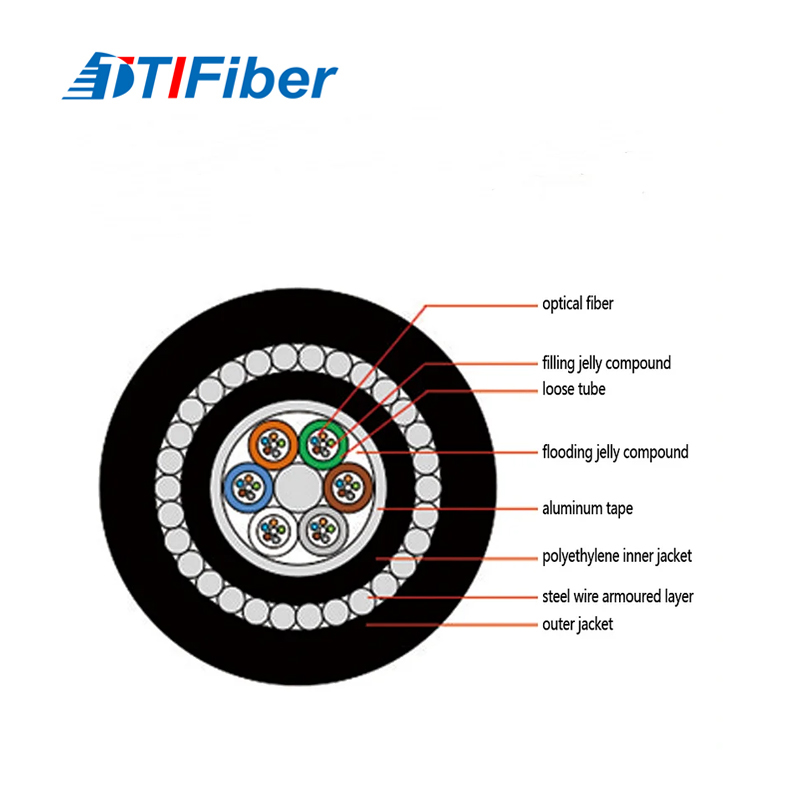
The steel used in SWA cables is not high-carbon tool steel, nor is it brittle cast iron. It is specifically low-carbon (mild) steel wire, typically containing less than 0.25% carbon.
What Kind of Steel Is Used in the SWA Layer

So what exactly does “correct” installation entail? Where do standards draw the line between best practice and code compliance? And why is grounding not just an electrical formality—but a foundational requirement for safety, reliability, and longevity?
What Do Electrical Codes Specifically Require for SWA Grounding
In a market where “SWA” can be loosely applied to substandard products, how do you ensure the cable you’re purchasing will truly perform as expected over its 25+ year design life? Verification isn’t optional—it’s essential. And it must happen before the cable leaves the factory, not after it fails in the field.
How Do You Verify the Quality of SWA Fiber Optic Cable
