GYTA Compare to GYTS and GYFTA
Table of Contents
How Does GYTA Compare to GYTS, GYFTA, and Other Outdoor Fiber Optic Cables?
In the world of fiber optic infrastructure, not all cables are created equal. On paper, they may carry the same type of fiber—G.652.D single-mode, 9/125 µm—and support the same data rates. But once deployed in the real world—beneath roads, across poles, or through deserts—their structural differences determine whether they survive for decades or fail in months.
Among the most widely used outdoor cable families are GYTA, GYTS, and GYFTA. Their names sound similar, their appearances nearly identical, yet their internal architectures reflect fundamentally different philosophies of protection, grounding, and environmental response.
So how do you choose the right one? The answer isn’t found in catalogs—it’s written in soil conditions, lightning maps, rodent activity, and grounding practices. Let’s break it down, layer by layer.
The Common Foundation Loose-Tube Design for Outdoor Use
Before diving into differences, it’s important to recognize what these cables share:
This shared DNA makes them all viable for duct, direct burial, or aerial use—but the metallic elements (or lack thereof) are where their paths diverge.
GYTA Fiber Optic Cables
GYTA = Optical cable (G) + Polyethylene sheath (Y) + Corrugated aluminum tape (T) + Aluminum-polyethylene laminate (A)
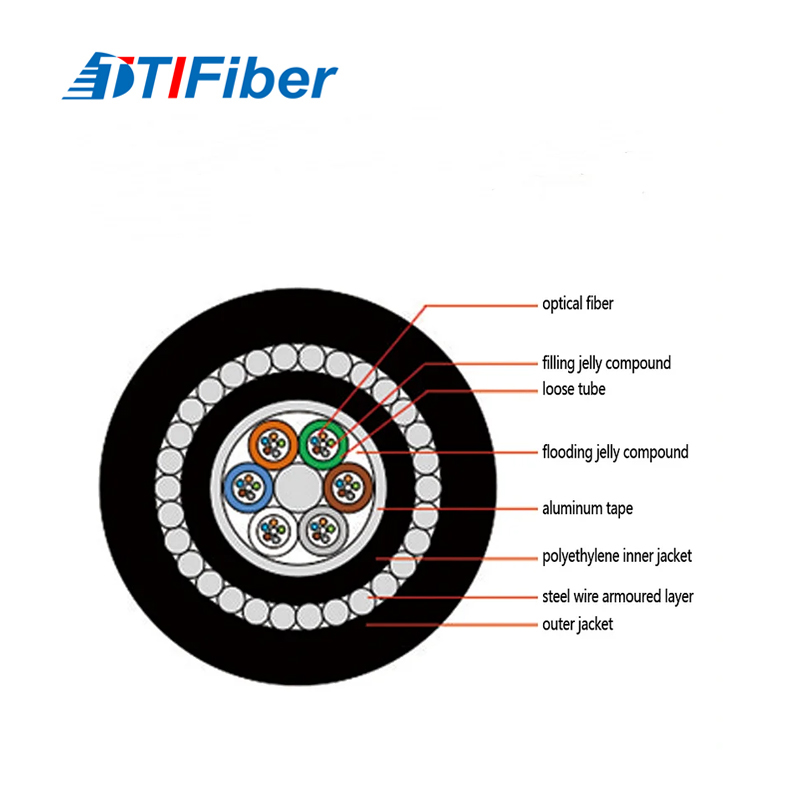
At its core, GYTA uses a corrugated aluminum tape wrapped longitudinally around the fiber tube bundle as a moisture and rodent barrier. This aluminum layer is lightweight, corrosion-resistant, and effective at blocking water ingress.
Best for: General-purpose outdoor deployments where cost, weight, and moisture protection are priorities—and where grounding can be reliably implemented.
GYTS Fiber Optic Cables
GYTS = Optical cable (G) + Polyethylene sheath (Y) + Corrugated aluminum tape (T) + Corrugated steel tape (S) instead of aluminum
Here, steel replaces aluminum as the moisture and mechanical barrier. The “S” stands for steel, and it changes everything.
Best for: High-risk mechanical environments—industrial sites, agricultural zones, mountainous regions, or anywhere physical abuse is expected.
GYFTA Fiber Optic Cables
GYFTA = Optical cable (G) + Polyethylene sheath (Y) + Non-metallic (FRP) strength member + Aluminum barrier (T) + All-dielectric design philosophy
Despite the “T” (which still denotes aluminum tape in many interpretations), true GYFTA often refers to a fully non-metallic cable—sometimes labeled more precisely as GYFTY (with “Y” for PE and no metal). Confusion arises because naming conventions vary by manufacturer.
But the critical distinction is this: GYFTA eliminates all continuous metal elements, using fiberglass-reinforced plastic (FRP) for the central strength member and swellable tapes instead of gel or metallic barriers in all-dielectric versions.
Best for: Aerial deployments in lightning-prone regions (e.g., tropical highlands), utility ROWs alongside transmission lines, or sensitive sites like airports and refineries where electrical isolation is mandatory.
Beyond the Big Three: Armored Variants (GYTA53, GYTA33)
When environments demand extreme protection, engineers turn to armored GYTA derivatives:
These are overkill for standard deployments but essential where failure is not an option—such as under highways, river crossings, or military installations.
GYTA / GYTS / GYFTA How to Choose the Right Cable?
Ask these questions before specifying:
Golden rule: When in doubt, match the cable to the worst-case environmental threat, not the average condition. A cable that survives a 100-year storm is worth the extra investment.
GYTA vs. GYTS vs. GYFTA Side-by-Side Comparison Table
The table below summarizes key differences across critical engineering and deployment dimensions:
Why Cables Fail Even When Chosen Correctly
Even the perfect cable fails if:
No cable type eliminates the need for trained installers, proper documentation, and post-installation testing (OTDR + insertion loss). The best design is only as good as its execution.
It’s Not Just Metal or No Metal—It’s About Context
GYTA, GYTS, and GYFTA aren’t competing products—they’re different answers to different questions. GYTA asks, “How do we protect light affordably in a moist world?” GYTS replies, “By armoring it against physical chaos.” GYFTA counters, “By removing electricity from the equation entirely.”
Choosing between them isn’t about specs alone. It’s about understanding the land, the climate, the threats, and the people who will maintain the network for decades.
In that sense, the cable you select doesn’t just carry light—it carries your judgment, your foresight, and your responsibility to build infrastructure that endures. And that’s a decision worth getting right.
2026 Top 15 Fiber Optic Cable Companies in the USA
Top 15 Fiber Optic Manufacturers
Related Article