How Is GYTA Fiber Optic Cable Constructed
Table of Contents
How Is GYTA Fiber Optic Cable Constructed—And Why Does That Design Work?
At first glance, a GYTA fiber optic cable looks like any other black, rugged tube snaking through trenches or strung between utility poles. But beneath its unassuming exterior lies a meticulously layered architecture—a defense-in-depth strategy forged over decades of field experience, material science, and lessons learned from real-world failures.
GYTA isn’t just “a cable with fiber inside.” It’s a system engineered to survive decades underground or overhead, in environments where moisture, temperature swings, rodents, and mechanical stress conspire to break the delicate thread of light within. To understand why GYTA remains one of the most trusted outdoor cable designs globally, we must examine not just what it’s made of—but why each layer exists, and how they work together as a unified whole.
The Core Philosophy: Protect the Fiber by Isolating It
The golden rule of fiber optic cable design is this: the optical fiber must experience zero strain, zero moisture, and zero abrupt movement over its lifetime. Even microscopic bending or tension can increase attenuation or cause latent failures. GYTA achieves this through a loose-tube, gel-filled, strain-relieved structure—a design so effective it has become the global standard for outdoor plant.
Let’s walk through the cable from the inside out.
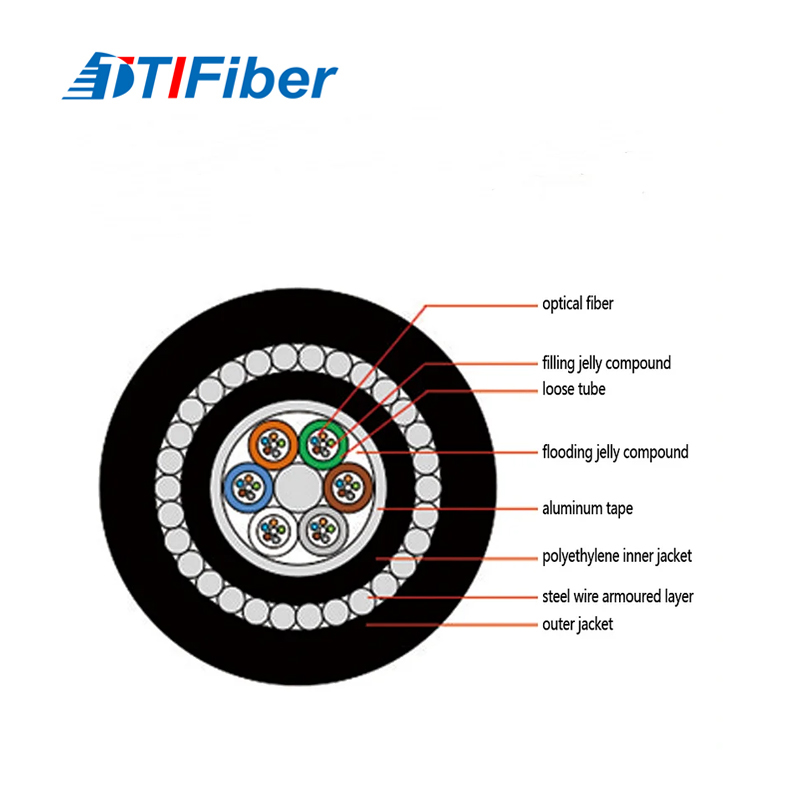
1. Optical Fibers: The Heart, But Never Under Stress
Inside GYTA, you’ll typically find 6 to 144 (or more) single-mode fibers, almost always compliant with ITU-T G.652.D—the “standard” single-mode fiber optimized for 1310 nm and 1550 nm transmission with low water peak.
Crucially, these fibers are not bonded or fixed to the cable structure. Instead, they reside inside semi-rigid plastic buffer tubes (usually made of PBT—polybutylene terephthalate), each about 2–3 mm in diameter. These tubes are intentionally oversized relative to the fiber, creating an air gap that allows the fiber to “float” freely.
This loose-tube design is fundamental: as the cable expands or contracts with temperature changes (which it inevitably will over a 50°C swing), the fiber isn’t stretched or compressed. It simply moves slightly within the tube—maintaining zero axial strain. Without this, thermal cycling alone could induce microbending losses or even break fibers over time.
2. Gel-Filled Tubes: The First Line of Moisture Defense
Each buffer tube is completely filled with a thixotropic water-blocking gel—a viscous, non-dripping compound that behaves like a solid until disturbed, then flows like a liquid under pressure.
This gel serves two critical purposes:
Yes, the gel is messy during splicing—but that inconvenience is a small price for decades of moisture immunity. (Note: “Dry” alternatives using swellable tapes exist—often labeled GYDTA—but traditional GYTA’s gel remains the gold standard for harsh, wet environments.)
3. Central Strength Member: The Backbone That Bears the Load
Wrapped around the buffer tubes—or sometimes at the very center—is a rigid central strength member, typically made of steel wire (sometimes glass-reinforced plastic in non-metallic variants like GYFTA).
This element is the cable’s mechanical spine. During installation, up to 600–1000 newtons of tensile force may be applied. The strength member absorbs all of it—ensuring the delicate fibers inside experience zero tension. Over the cable’s lifetime, it also resists sag in aerial spans and deformation under soil load in buried applications.
Without this, pulling a cable through a duct could stretch fibers beyond their elastic limit, causing immediate breakage or delayed “fiber fatigue” failure.
4. Helical Stranding: Accommodating Movement Without Damage
The gel-filled buffer tubes are stranded in a helical pattern around the central strength member—like threads wrapped around a screw. This isn’t just for neatness; it’s functional geometry.
The helix introduces controlled excess fiber length (typically 0.5–1%). As the cable bends, stretches, or contracts, this slack allows the tubes to shift slightly without transferring stress to the fibers. Think of it like coiling a garden hose: the loops absorb movement so the water inside flows undisturbed.
The stranding pitch (how tightly the helix is wound) is carefully calculated to balance flexibility, bending radius, and fiber protection.
5. Aluminum-Polyethylene Moisture Barrier: The Metallic Shield
This is where GYTA earns its “T” and “A.” Wrapped tightly around the stranded tube bundle is a longitudinally corrugated tape made of aluminum laminated with polyethylene (Al-PE). This layer is often mistakenly called “armor”—but it’s not. Its primary role is moisture and rodent protection, not crush resistance.
Critically, this tape is seam-welded or overlapped with adhesive to ensure no gaps. A pinhole leak here could compromise the entire moisture defense strategy.
6. Polyethylene Outer Sheath: The Final Skin Against the World
The outermost layer is a thick (typically 1.8–2.5 mm), black polyethylene (PE) jacket, specially formulated for outdoor use. This isn’t ordinary plastic—it’s engineered to withstand:
This sheath is the cable’s first line of defense—designed to take the hits so the delicate layers inside never see them.
Why This Design Works: Synergy, Not Just Layers
What makes GYTA so effective isn’t any single component—it’s how they work together as a system:
If one layer is compromised—say, a shovel nick in the PE jacket—the next layer (aluminum tape) still protects the core. If water somehow gets past that, the gel stops it from spreading. This redundant protection is why GYTA cables routinely last 25–30 years, even in harsh conditions.
A Note on Grounding: The Hidden Responsibility
Because GYTA contains metallic aluminum, it becomes an unintentional conductor when installed aerially or near power lines. During lightning strikes or power faults, dangerous voltages can be induced on the tape.
Therefore, proper grounding is non-negotiable. The aluminum moisture barrier must be bonded to an earth ground at every splice closure and termination point. Skipping this turns a protective feature into a safety hazard—a lesson learned the hard way in early deployments.
Final Thought: Engineering as Foresight
GYTA’s construction reflects a profound engineering ethos: anticipate failure, then design it out. Every layer answers a specific “what if?”:
In an age of rapid obsolescence, GYTA endures not because it’s cutting-edge, but because it’s thoughtfully complete. It doesn’t chase bandwidth records—it ensures that the bandwidth you have stays available, year after year, rain or shine.
And in the quiet reliability of that black cable buried beneath your street, there’s a kind of poetry: a promise, wrapped in polyethylene, sealed against time.


GJPFJH 12-Core Bundled Indoor Fiber: Small Cable, Big Connectivity Wins!
Will Signal Blur Over Long Distances in Optical Fiber
Related Article