



MDPE vs HDPE Fiber Optic Cable SEO Core Materials
author: TTI Fiber
2026-05-22
If you’ve spent any time pulling fiber optic cables through ducts, burying lines underground, or running overhead FTTx deployments, you’ve definitely encountered this confusing dilemma: MDPE or HDPE fiber cable sheath? To the untrained eye, these two polyethylene jackets look identical—black, smooth, tough plastic that wraps every outdoor fiber optic cable. But ask any seasoned telecom contractor, and they’ll tell you picking the wrong one is the fastest way to ruin a perfect installation.
Choose HDPE fiber optic cable sheath for a tight urban duct pull, and you’ll fight unnecessary stiffness and risk micro-bending your fibers. Grab MDPE fiber optic cable sheath for a direct-buried roadside run, and you might end up with cracked jackets and compromised network longevity after a single harsh winter. This is the real difference between MDPE and HDPE fiber optic cables that spec sheets never tell you. Today, we’re breaking down MDPE vs HDPE fiber optic cable differences in plain, field-tested language—no stuffy academic jargon, no generic AI fluff, just honest pros-and-cons every installer and project manager needs to know.
First Things First: What Are MDPE and HDPE Fiber Optic Cable Sheaths?
Before jumping into the head-to-head battle, let’s clarify what MDPE and HDPE actually stand for and why they dominate fiber optic cable outer sheaths. Both are polyethylene-based thermoplastics engineered specifically for fiber cable protection, but their molecular density, structural makeup, and core performance traits set them worlds apart.
HDPE (High-Density Polyethylene) for fiber optic cables features a tightly packed linear molecular structure with minimal chain branching. Its high density rating (0.941–0.965 g/cm³) delivers exceptional rigidity, hardness, and mechanical strength. Manufacturers favor HDPE fiber cable sheaths for applications requiring maximum crush resistance, stress crack resistance, and long-term outdoor durability. It’s the “heavy-duty body armor” of fiber cable jackets, built to withstand relentless environmental abuse.
MDPE (Medium-Density Polyethylene) for fiber optic cables sits perfectly in the middle of the polyethylene spectrum. With a density range of 0.926–0.940 g/cm³ and moderate molecular chain branching, MDPE fiber optic cable sheath trades a small amount of raw rigidity for superior flexibility and impact toughness. Unlike rigid HDPE, MDPE fiber cable bends easier, coils smoother, and resists cracking during tight pulls or low-temperature bending—making it the “installer-friendly” option for complex routing jobs.
The biggest misconception in the telecom industry is that “higher density = always better.” When it comes to fiber optic cable performance, that rule does not apply. The true difference between MDPE and HDPE fiber optic cables lies inapplication matching, not raw material density.
Core MDPE vs HDPE Fiber Optic Cable Differences (Field-Proven Performance)
Most online guides only list generic material specs. We’re focusing on how MDPE and HDPE fiber cable sheaths actually perform on job sites—during pulling, burying, overhead installation, and years of outdoor exposure. Every difference below directly impacts installation speed, network reliability, and long-term maintenance costs.
1. Flexibility & Installation Friendliness
This is where MDPE fiber optic cable sheath dominates. MDPE’s branched molecular structure delivers excellent low-temperature flexibility and ductility. When you’re pulling fiber through winding microducts, navigating building entry bends, or coiling excess cable on-site, MDPE fiber cable moves with you. It rarely kinks or cracks, even in freezing weather, and cuts down installation time significantly.
HDPE fiber optic cable sheath, by contrast, is structurally stiff and rigid thanks to its dense linear molecules. While that rigidity boosts strength, it makes HDPE fiber cable harder to maneuver in tight spaces. Aggressive bending or fast pulls on HDPE sheaths can cause micro-damage to the outer jacket, and in worst-case scenarios, induce fiber micro-bending that degrades signal performance. HDPE works great for straight, open runs but fights you every step of the way on complex routes.
2. Mechanical Strength & Crush Resistance
If flexibility is MDPE’s superpower, brute strength is HDPE’s specialty. HDPE fiber optic cable sheath boasts superior tensile strength, hardness, and crush resistance. For direct-buried fiber deployments, roadside installations, or areas prone to heavy soil pressure, construction impact, or vehicle vibration, HDPE fiber cable outperforms MDPE every time.
HDPE’s outstanding environmental stress crack resistance (ESCR) prevents jacket splitting under long-term mechanical pressure—a critical feature for underground fiber networks that need 20+ year lifespans. MDPE fiber cable sheath offers solid mechanical protection but cannot match HDPE’s ability to withstand continuous heavy compression and physical abrasion.
3. Weather & Temperature Tolerance
Both MDPE and HDPE fiber optic cable sheaths include carbon black UV stabilization, delivering reliable outdoor UV resistance for long-term aerial and buried use. Where they differ is extreme temperature performance.
MDPE fiber cable maintains its flexibility at subzero temperatures, making it ideal for cold-climate installations where rigid jackets crack easily. HDPE fiber optic cable sheath holds its structural integrity better in sustained high heat and resists thermal deformation better than MDPE. For regions with extreme summer heat, HDPE prevents jacket sagging and material fatigue, while MDPE remains the top choice for frigid winter environments.
4. Chemical & Corrosion Resistance
HDPE fiber optic cable sheath features tighter molecular packing, delivering marginally better resistance to chemicals, acids, alkalis, and soil contaminants than MDPE fiber cable. For fiber routes running through industrial zones, fertilized farmland, or chemically active soil, HDPE provides an extra layer of corrosion protection. MDPE still offers excellent chemical resistance for standard residential and commercial deployments but falls slightly short in harsh industrial environments.
MDPE vs HDPE Fiber Cable Comparison Table (Job-Site Focused)
This optimized table highlights only the practical, project-critical differences between MDPE and HDPE fiber optic cables, making it easy to select the right sheath for your FTTx, backbone, and campus projects at a glance.
|
Performance Parameter
|
MDPE Fiber Optic Cable Sheath
|
HDPE Fiber Optic Cable Sheath
|
|---|---|---|
|
Density Range
|
0.926–0.940 g/cm³ (medium density)
|
0.941–0.965 g/cm³ (high density)
|
|
Flexibility & Bending Performance
|
Excellent; low-temperature flexible, kink-resistant, installer-friendly
|
Good; rigid structure, prone to micro-bending in tight routes
|
|
Crush & Impact Resistance
|
Standard; suitable for light to medium mechanical load
|
Superior; ideal for heavy buried load & impact-prone areas
|
|
Stress Crack Resistance
|
Good for short-term & low-stress applications
|
Exceptional for long-term underground static pressure
|
|
Temperature Adaptability
|
Best for cold climates; retains flexibility below -20°C
|
Best for hot climates; resists thermal deformation
|
|
Chemical Resistance
|
Great for standard residential & commercial environments
|
Superior for industrial & chemically active soil zones
|
|
Best Application Scenarios
|
Duct installation, indoor-outdoor routing, complex bends, cold-region FTTx
|
Direct burial, aerial backbone, roadside routes, industrial fiber networks
|
Common MDPE & HDPE Fiber Cable Myths Busted
Years of field work have exposed countless misleading myths about MDPE vs HDPE fiber optic cable differences that waste contractors time and money. Let’s debunk the most prevalent ones once and for all.
Myth 1: HDPE fiber cable is always better than MDPE fiber cable. False. HDPE’s rigidity becomes a liability in duct installations with multiple bends. Many unnecessary fiber faults happen yearly because installers used HDPE fiber optic cable where flexible MDPE fiber cable was the correct choice. Better density does not equal better overall performance.
Myth 2: MDPE fiber optic cable sheath is less durable. False. MDPE fiber cable offers decades of reliable service in its intended applications. It only underperforms HDPE under extreme mechanical compression. For duct-based FTTx projects (the most common fiber deployment type globally), MDPE durability matches or exceeds project requirements.
Myth 3: Both MDPE and HDPE fiber cables are interchangeable. Absolutely false. Swapping these two sheath materials randomly is a top cause of premature network failure. Direct-buried MDPE fiber cable will crack under sustained soil pressure, while duct-run HDPE fiber cable slows down installation and increases fiber micro-bend loss risks.
How to Choose: MDPE or HDPE Fiber Optic Cable for Your Project?
Choosing between MDPE and HDPE fiber optic cables is simple when you prioritize installation environment and mechanical demand, not generic specs. Use this no-nonsense guide for perfect material selection every time.
Choose MDPE Fiber Optic Cable if:
✅ You are installing fiber via microduct or conventional duct routing
✅ Your project features multiple bends, tight spaces, or complex building entry points
✅ Deployment takes place in cold or freezing climate zones
✅ You need fast, smooth pulls with minimal risk of jacket kinking
✅ Standard residential, commercial, and campus FTTx networks
Choose HDPE Fiber Optic Cable if:
✅ You require direct-buried fiber deployment with no duct protection
✅ Installing aerial fiber backbones, roadside routes, or industrial fiber lines
✅ The site features heavy soil pressure, construction activity, or vehicle vibration
✅ Hot climate regions with prolonged high-temperature exposure
✅ Industrial zones with chemical or soil contamination risks
Why Choose TTI Fiber for MDPE & HDPE Fiber Optic Cables
Understanding the difference between MDPE and HDPE fiber optic cables only adds value if your cables use genuine, high-quality sheath materials. Low-grade generic MDPE and HDPE jackets cut corners on molecular purity, UV stabilization, and stress crack resistance—leading to premature failure even with perfect installation practices. This is why professional contractors worldwide consistently choose TTI Fiber for all fiber cable sheath variants.
Founded in 2013, TTI Fiber Communication Tech. Co., Ltd., is a professional manufacturer specializing in Fiber optic products. Our factory located in Shenzhen, China, covers an area of 12,000 square meters and has obtained ISO 9001, ISO 14001, REACH, RoHS, CE and CPR certificates and so on. We have a wide range of fiber optic products, including Fiber Optic Cable, Fiber Optic Patch Cord, Fiber Optic Splitter, Fiber Optic Patch Panel, FTTx products, etc. We also provide professional Fiber Cabling Solutions and one-stop OEM & ODM service. Our main markets are in North America, South America, Europe, Africa and Asia. Our reliable quality and sincere service are highly recognized by our clients all over the world. We cooperated with Global 500 top brands on FTTx products, and more than 30 well-known brand clients in fiber optic industry. Our products are exported to over 100 countries. We are committed to providing our clients with the best support, regardless of their business scale. Our expertise and knowledge of market trends, enables us provide technical support and matched solutions on fiber optic products. We are proud of providing excellent quality, competitive price and timely delivery.
All TTI Fiber MDPE fiber optic cable and HDPE fiber optic cable products adopt virgin-grade polyethylene materials with precise density calibration, uniform molecular structure, and high-purity carbon black UV protection. Every batch undergoes strict mechanical flexibility, crush resistance, low-temperature bending, and weathering testing to ensure strict compliance with international telecom standards. Unlike cheap alternatives that mix recycled materials, TTI Fiber’s MDPE and HDPE fiber cable sheaths deliver consistent performance, zero premature cracking, and a 20+ year service life.
Whether you need flexible MDPE fiber cable for complex duct FTTx deployments or ultra-tough HDPE fiber cable for direct-buried backbone projects, TTI Fiber provides customized core counts, sheath specifications, and full technical guidance. Our team helps clients accurately select between MDPE and HDPE fiber optic cables based on project environments, eliminating material mismatch risks and reducing long-term maintenance costs. With stable supply, competitive pricing, and on-time global delivery, TTI Fiber is the trusted partner for fiber cabling projects across 100+ countries.
Final Verdict: MDPE vs HDPE Fiber Optic Cable
There is no universal “better” option between MDPE and HDPE fiber optic cables—only the right material for the right job. HDPE fiber optic cable is the heavy-duty workhorse for high-stress, exposed, and buried fiber routes, delivering unmatched mechanical protection and chemical resistance. MDPE fiber optic cable is the installer-friendly champion for duct routing, complex bends, and cold-region deployments, prioritizing flexibility and easy installation.
Mastering the difference between MDPE and HDPE fiber optic cables separates amateur installs from professional, long-lasting networks. By matching TTI Fiber’s premium MDPE and HDPE fiber cable products to your project’s specific environmental and mechanical needs, you eliminate unnecessary faults, speed up construction, and build fiber networks that stand the test of time.
If you’re still unsure which sheath material fits your upcoming deployment, the TTI Fiber technical team offers free project evaluation and material selection advice—no sales pressure, only field-tested professional guidance.
Top 15 Fiber Optic Cable Companies in Europe 2026
GJYFJY Indoor-Outdoor Fiber Optic Cable: No More Switching Cables (Thank God!)
Related Article
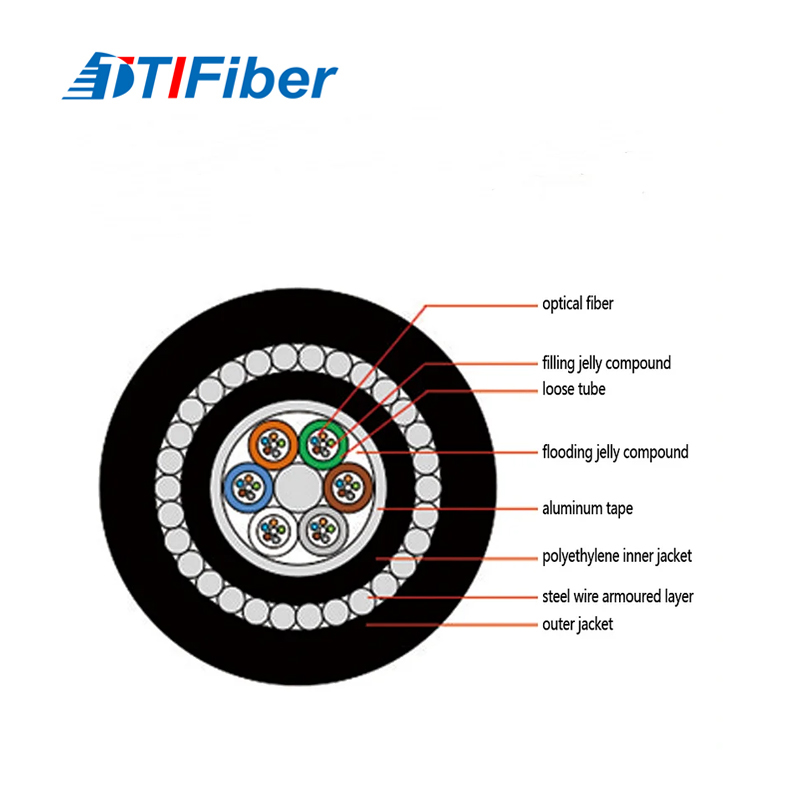
The steel used in SWA cables is not high-carbon tool steel, nor is it brittle cast iron. It is specifically low-carbon (mild) steel wire, typically containing less than 0.25% carbon.
What Kind of Steel Is Used in the SWA Layer

So what exactly does “correct” installation entail? Where do standards draw the line between best practice and code compliance? And why is grounding not just an electrical formality—but a foundational requirement for safety, reliability, and longevity?
What Do Electrical Codes Specifically Require for SWA Grounding
In a market where “SWA” can be loosely applied to substandard products, how do you ensure the cable you’re purchasing will truly perform as expected over its 25+ year design life? Verification isn’t optional—it’s essential. And it must happen before the cable leaves the factory, not after it fails in the field.
How Do You Verify the Quality of SWA Fiber Optic Cable
