What Is GYFTY
What Is GYFTY? Decoding the Anatomy of a Workhorse Outdoor Fiber Cable
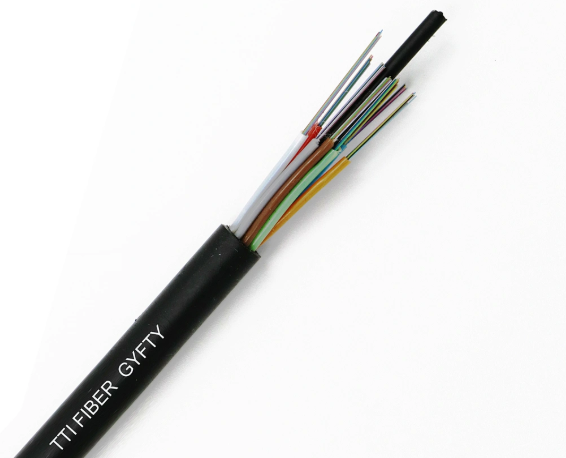
In the world of fiber optic infrastructure, cables aren’t just labeled with numbers—they speak a coded language. “GYFTY” might look like a random string of letters, but to engineers and installers, it’s a precise blueprint of construction, materials, and intended use.
So what does GYFTY actually mean? And why does this particular cable type appear so often in aerial, duct, and direct-burial deployments across Asia, Africa, and beyond?
Let’s unpack the name, the structure, and the real-world role of GYFTY—one layer at a time.
What Does “GYFTY” Stand For—And Why Should You Care?
GYFTY isn’t a brand or a model number. It’s a standardized designation based on Chinese national standards (GB/T) and widely adopted across global markets. Each letter reveals a critical attribute of the cable’s design:
- G = Guang (光) – “Optical,” indicating it’s a fiber optic cable.
- Y = Polyethylene (PE) outer sheath – tough, UV-resistant, and ideal for outdoor exposure.
- F = Non-metallic strength member – typically aramid yarn (like Kevlar®) or fiberglass-reinforced plastic (FRP) rods.
- T = Filling compound – a water-blocking gel or dry swellable tape inside the cable core.
- Y = Again, polyethylene outer jacket – confirming full outdoor rating.
Put together: GYFTY = Outdoor fiber optic cable with non-metallic reinforcement, water-blocking protection, and a PE sheath.
This naming convention matters because it tells you, at a glance, whether the cable is suitable for lightning-prone areas, rodent zones, or environments where electrical isolation is critical.
How Is GYFTY Constructed—And What Makes It Different From Other Cables?
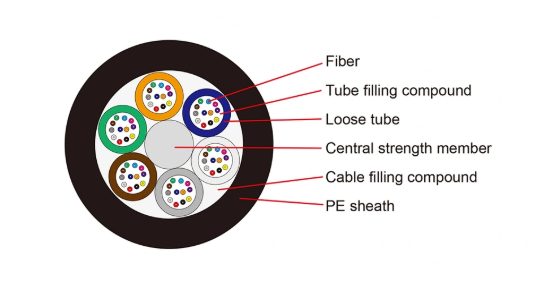
GYFTY follows a loose-tube design, optimized for harsh outdoor conditions. Here’s how it’s built, from the inside out:
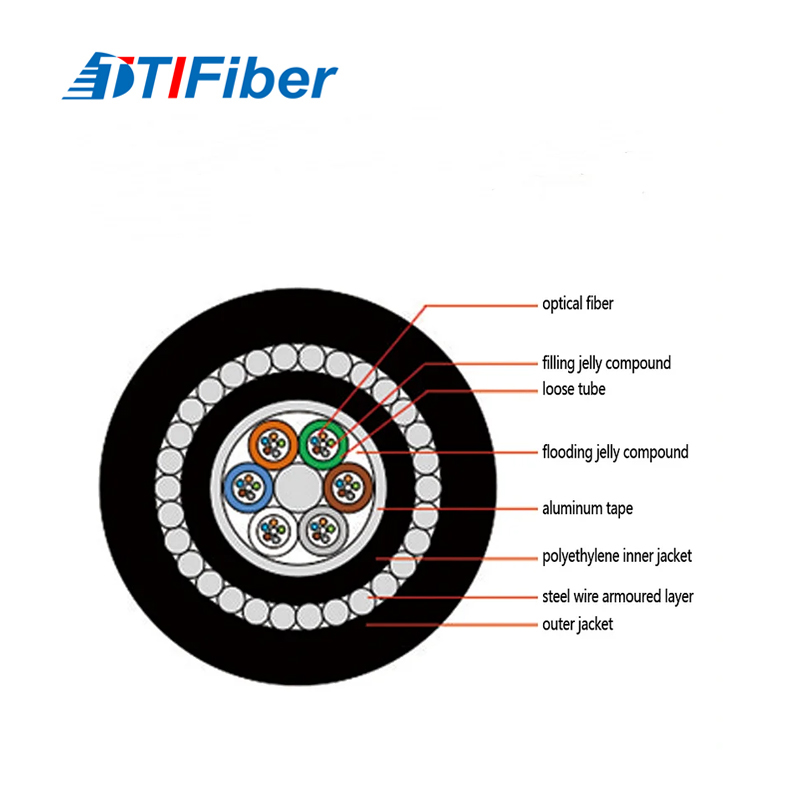
- Optical Fibers: Typically 2–144 single-mode (G.652.D) or multimode fibers, housed within buffer tubes.
- Loose Buffer Tubes: Made of PBT (polybutylene terephthalate), these tubes protect fibers from mechanical stress and allow movement during temperature changes. Tubes are often color-coded for identification.
- Water-Blocking: The interstices between tubes are filled with petroleum-based gel or lined with dry water-swellable tapes/yarns that expand upon contact with moisture—preventing longitudinal water ingress.
- Non-Metallic Central Strength Member: A rigid FRP rod runs down the center, providing tensile strength without conducting electricity. This is the key differentiator from metallic cables like GYTA (which uses an aluminum strip).
- Aramid Yarn Layer: Wrapped around the core for additional tensile support and crush resistance.
- Outer Sheath: A black or gray polyethylene (PE) jacket, UV-stabilized and rated for -40°C to +70°C operation.
This all-dielectric construction makes GYFTY immune to lightning strikes and electromagnetic interference—a crucial advantage in rural power corridors, railway lines, or near high-voltage substations.
Where Is GYFTY Used—And Why Choose It Over Alternatives?
GYFTY shines in applications where electrical isolation, corrosion resistance, and long-term outdoor durability are non-negotiable:
- Aerial installations: Strung between poles without grounding concerns. Its lightweight, non-conductive nature eliminates induced voltages from nearby power lines.
- Direct burial: In areas with high lightning activity or poor grounding, GYFTY avoids the risk of ground potential rise damaging equipment.
- Duct installations: Especially in congested urban conduits shared with power cables, where EMI or accidental contact could be hazardous.
- Mining, oil & gas, and military sites: Where spark-free, non-metallic cabling is a safety requirement.
Compared to GYTA (which has an aluminum moisture barrier), GYFTY trades slight mechanical ruggedness for complete dielectric safety. Compared to GYTS (corrugated steel tape), it’s lighter and easier to handle—but less rodent-resistant unless armored separately.
In short: choose GYFTY when safety from electrical hazards outweighs the need for extreme mechanical armor.
What Are the Key Performance Characteristics?
While specs vary by manufacturer, typical GYFTY performance includes:
- Operating temperature: -40°C to +70°C
- Tensile strength: 600–1500 N (short-term), depending on fiber count and yarn layers
- Crush resistance: 300–1000 N/10 cm
- Bend radius: 15× cable diameter (static), 25× (during installation)
- Water penetration: No longitudinal seepage after 1m x 24h immersion (per IEC 60794)
- Fire rating: Generally not plenum-rated; intended for outdoor use only
Note: GYFTY is not suitable for indoor runs due to its lack of flame-retardant jacketing (e.g., LSZH). Always transition to indoor-rated cable (like GJFJV) at building entry points.
Are There Common Pitfalls When Installing GYFTY?
Yes—despite its robustness, GYFTY demands respect for its design limits:
- Over-tensioning: While strong, aramid yarn can stretch permanently if pulled beyond spec, leading to fiber strain.
- Sharp bends: The loose-tube design tolerates bending better than tight-buffered cable—but exceeding minimum bend radius still causes microbending loss.
- Gel cleanup: If using gel-filled versions, thorough cleaning of fibers before splicing is essential. Many modern variants now use dry water-blocking to avoid this.
- UV degradation: Though PE is UV-stabilized, prolonged exposure beyond 25 years may embrittle the jacket. Inspect aging aerial cables periodically.
Pro tip: Always verify whether your GYFTY is gel-filled or dry-core—it affects splicing workflow and closure selection.
So—Is GYFTY the Right Choice for Your Project?
That depends on your environment, not your budget. GYFTY isn’t the cheapest cable, nor the toughest—but it’s the safest all-dielectric solution for outdoor plant where electricity and optics must coexist without conflict.
If your route crosses power lines, runs through lightning-prone terrain, or serves critical infrastructure where a single ground fault could cascade into system failure, GYFTY isn’t just an option—it’s a responsibility.
And in the quiet language of cable codes, that’s exactly what those five letters promise: light, guided safely through a world of storms and sparks, with nothing metallic to betray it.


GCYFXF Fiber Optic Cable: The Lightweight Hero for Hassle-Free Network Wiring
Difference Between MDPE and HDPE of Fiber Optic Cables
Related Article