Will Signal Blur Over Long Distances in Optical Fiber

Why Doesn’t the Signal Blur Over Long Distances in Optical Fiber?
When a pulse of light leaves a transmitter in New York, bound for London across 6,000 kilometers of undersea fiber, it carries more than data—it carries a promise. A promise that, despite the ocean’s pressure, temperature shifts, and the sheer scale of distance, the signal will arrive not as a smeared ghost, but as a crisp, decipherable message.
Yet light, like all waves, wants to spread. It diffracts. It scatters. It interacts with the very medium that carries it. So why—against all intuition—doesn’t an optical signal blur into uselessness over such vast spans?
The answer isn’t that fiber magically defies physics. It’s that every layer of the system—from the purity of the glass to the intelligence of the receiver—is engineered to honor the integrity of light. Let’s explore how.
The Two Enemies of Clarity: Loss and Dispersion
Over distance, optical signals face two fundamental threats:
- Attenuation – the gradual weakening of light as it travels.
- Dispersion – the spreading or “blurring” of light pulses over time.
While attenuation determines how far a signal can go before it fades, dispersion determines how fast you can send data before pulses overlap and become unreadable. In high-speed systems—100G, 400G, even 1.6T—dispersion is often the tighter constraint. A signal might still be bright enough at 1,000 km, but if its pulses have smeared into one another, the data is lost.
So how do we keep those pulses sharp?
First: We Start with Exceptionally Pure Glass
Not all glass is created equal. Ordinary window glass would absorb a signal within meters. Optical fiber, by contrast, is made of ultra-pure synthetic silica (SiO₂), refined to eliminate impurities that cause scattering or absorption.
The dominant loss mechanism in modern fiber is Rayleigh scattering—caused by microscopic density fluctuations frozen into the glass during manufacturing. This isn’t a defect; it’s a thermodynamic inevitability. But through decades of process refinement, we’ve pushed attenuation down to just 0.17 decibels per kilometer at 1550 nm—the lowest loss window in silica.
What does that mean in practice?
At 1550 nm, a signal loses only half its power every 18 kilometers. After 100 km, about 1.5% of the original light remains—enough for sensitive receivers to detect. This low loss gives us the distance; now we need to preserve timing.
Then: We Engineer the Fiber to Control How Light Travels
Dispersion isn’t a single phenomenon—it comes in flavors, each addressed by design:
Chromatic Dispersion: When Colors Run at Different Speeds
Even a “single” laser emits a narrow band of wavelengths. In glass, shorter wavelengths (bluer) travel slightly slower than longer ones (redder). Over distance, this causes a pulse to stretch—a problem known as chromatic dispersion.
In standard single-mode fiber (ITU-T G.652), this effect peaks at about 17 picoseconds of spread per nanometer of spectral width, per kilometer. For a 10 Gbps signal, that limits unrepeated reach to ~60 km. For 400G coherent systems using wide modulation bandwidths, it would be catastrophic—if unmanaged.
But we don’t leave it unmanaged. Instead, we use:
- Dispersion-optimized fibers: Non-Zero Dispersion-Shifted Fiber (G.655) introduces a small, controlled amount of dispersion in the C-band (1530–1565 nm) to suppress nonlinear effects while keeping pulse spreading manageable.
- Large Effective Area Fiber (LEAF): By widening the mode field, power density drops, reducing both dispersion-induced penalties and nonlinear distortions like four-wave mixing.
These aren’t workarounds—they’re deliberate optical choreography, ensuring light waves stay in step.
Polarization-Mode Dispersion (PMD): When Light Takes Two Paths
Even in “single-mode” fiber, light has two polarization states. Imperfections—core ellipticity, stress, bends—cause these states to travel at slightly different speeds. Over thousands of kilometers, this creates differential group delay, blurring pulses.
High-speed fiber is drawn under extreme tension control to ensure near-perfect circularity and homogeneity. Modern cables achieve PMD below 0.05 picoseconds per square root of kilometer—low enough for 800G coherent transmission across oceans.
But the Real Breakthrough? We Let the Receiver “Undo” the Blur
Even with perfect fiber, some distortion is inevitable. The true revolution came not from eliminating dispersion—but from compensating for it mathematically.
Enter coherent detection and digital signal processing (DSP):
At the receiver, a local oscillator laser interferes with the incoming signal, capturing not just intensity but also phase and polarization. This rich data stream is digitized and fed into a DSP chip that runs real-time algorithms to:
- Reverse chromatic dispersion (even for 10,000+ km of fiber)
- Compensate for PMD
- Correct nonlinear phase noise
- Recover the original constellation (e.g., 64-QAM)
It’s as if the receiver has a time-reversal lens—reconstructing the signal as it was before the fiber blurred it.
This synergy—between low-dispersion fiber and intelligent electronics—has turned dispersion from a hard limit into a solvable variable.
And We Amplify Without Converting Back to Electricity
To span oceans, signals must be boosted—but traditional repeaters (optical → electrical → optical) would bottleneck speed and add latency.
Instead, we use Erbium-Doped Fiber Amplifiers (EDFAs). These devices pump energy into a doped fiber segment, causing incoming photons to stimulate the emission of identical photons—amplifying all C-band wavelengths simultaneously, in the optical domain.
Because EDFAs don’t “look” at the data, they preserve modulation format and phase—enabling transparent, multi-terabit transmission. No conversion. No bottleneck. Just light, gently renewed.
The Bigger Picture: It’s Not About Preventing Blur—It’s About Managing It
We’ve moved beyond the dream of a “perfect” fiber that never distorts. Instead, we’ve built a holistic system where:
- The glass minimizes intrinsic blurring,
- The cable design suppresses environmental perturbations,
- The amplifiers extend reach without corruption,
- And the receiver actively reconstructs the signal.
This is systems engineering at its finest: not fighting physics, but dancing with it.
So when a 400G signal crosses the Atlantic, it’s not because the fiber is flawless. It’s because every element—from the dopant profile in the preform to the algorithm in the DSP—has been tuned to ensure that light, though stretched and scattered, never loses its meaning.
And in an age where data is the lifeblood of civilization, that clarity—preserved over thousands of kilometers—is nothing short of extraordinary.


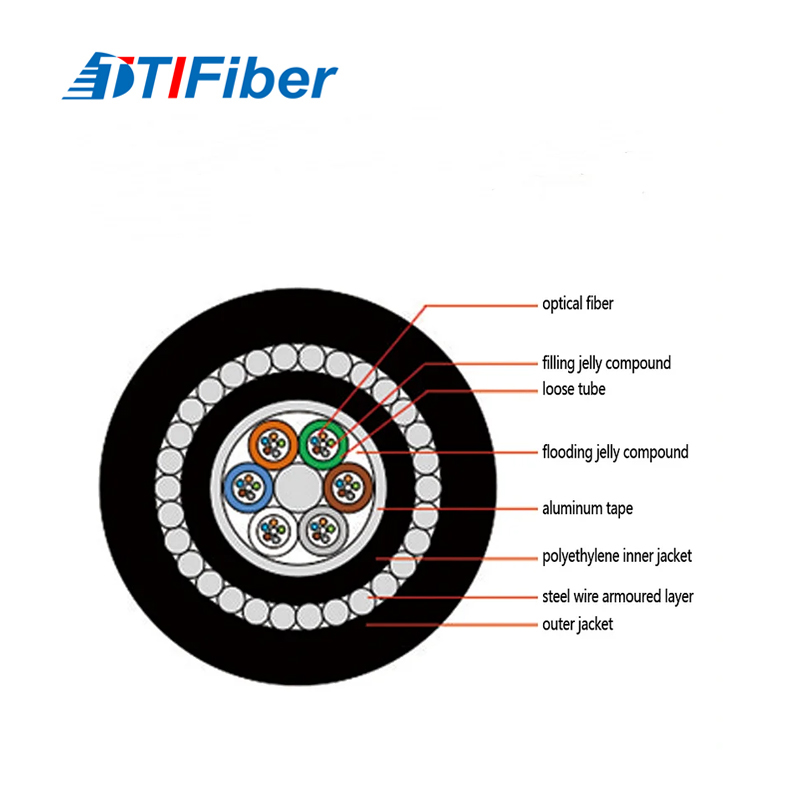
How Is GYTA Fiber Optic Cable Constructed
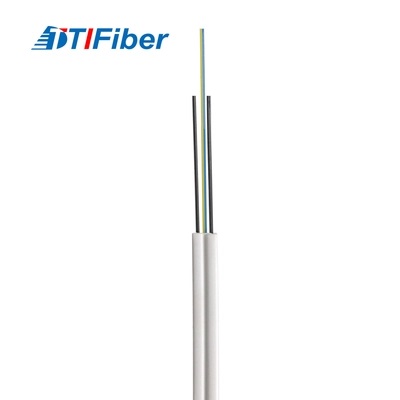
GJFSH Indoor Fiber Cable Core Count: What You Need to Know for Your Network
Related Article