Direct Burial Fiber Optic Cable vs. Regular Fiber Optic Cable
What Is the Difference Between Direct Burial Fiber Optic Cable and Regular Fiber Optic Cable?
When deploying fiber optic infrastructure—whether for a rural broadband expansion, a campus backbone, or a utility smart grid—the choice of cable isn’t just about optics. It’s about survival. Not all fiber cables are created equal, and using the wrong type in the wrong environment can lead to premature failure, costly repairs, and service outages that last weeks.
Among the most critical distinctions is between direct burial fiber optic cable and what’s often called “regular” fiber—typically indoor or aerial cable. But what truly sets them apart? Is it just the jacket color? Or is there deeper engineering at play?
Let’s explore the real differences—not as marketing terms, but as practical, physics-driven design choices that determine whether your fiber lasts five years or fifty.
What Does “Direct Burial” Actually Mean—and Why Can’t You Just Bury Any Fiber?
“Direct burial” means the cable is engineered to be placed directly into the ground without conduit, exposed to soil, moisture, rocks, rodents, and shifting earth pressures. This is not a minor detail—it’s a fundamental rethinking of cable construction.
Regular fiber optic cables (e.g., indoor riser or plenum-rated) assume a controlled environment: stable temperature, no water, no crushing loads, and protection from physical intrusion. Burying such a cable is like planting a houseplant in a desert—it might survive briefly, but it wasn’t built for that world.
Direct burial cables, by contrast, are armored fortresses for light. They’re designed to withstand:
- Soil acidity and chemical exposure
- Groundwater immersion for decades
- Rodent and insect attack
- Tensile stress during installation
- Lateral pressure from rocks or backfill
Using non-burial cable underground isn’t just risky—it often voids manufacturer warranties and violates national codes (like NEC Article 770 in the U.S.).
How Is Direct Burial Cable Structurally Different From Indoor or Aerial Cable?
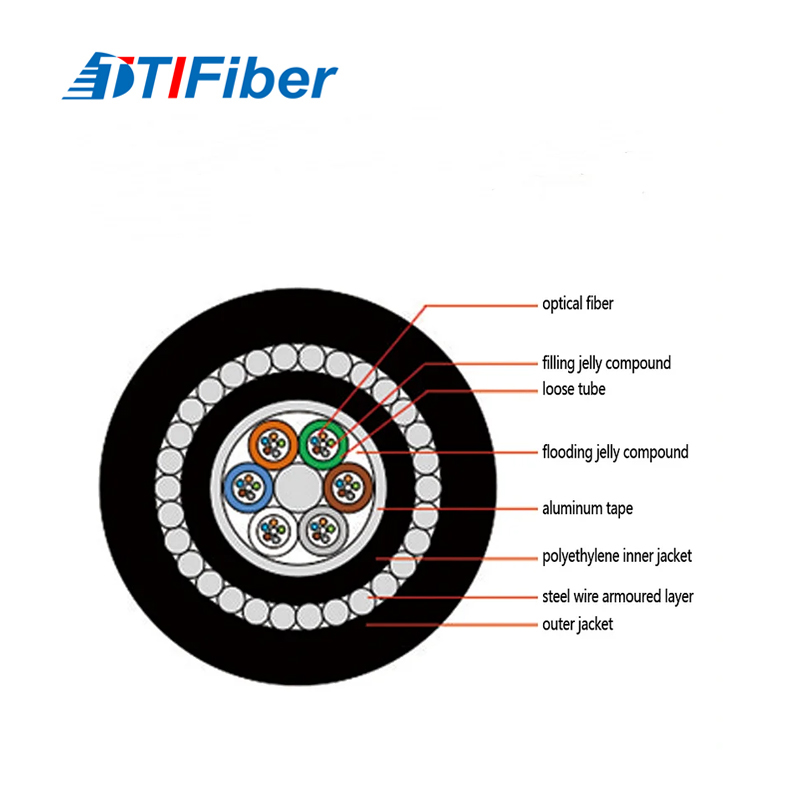
The differences go far beyond a thicker jacket. Direct burial cable incorporates multiple layers of mechanical and environmental protection, each serving a specific purpose:
1. Water-Blocking Elements
- Indoor cable: Relies on dry, climate-controlled spaces. No water protection needed.
- Direct burial cable: Contains gel-filled tubes, dry water-swellable tapes, or powder-based blockers that expand upon contact with moisture, sealing the cable core and preventing longitudinal water migration—even if the sheath is breached.
2. Armor Layer
- Indoor cable: Typically has only a flame-retardant PVC or LSZH (Low Smoke Zero Halogen) jacket.
- Direct burial cable: Often includes a corrugated steel tape (CST) or interlocking aluminum armor beneath the outer jacket. This armor resists:
- Crushing from rocks or heavy equipment
- Rodent gnawing (a leading cause of rural outages)
- Shovel cuts during excavation
Some variants even use double armor for high-risk zones like agricultural fields or railway corridors.
3. Strength Members
- Indoor cable: Uses aramid yarn (Kevlar®) for tensile strength—lightweight but not crush-resistant.
- Direct burial cable: Employs steel wire strength members (central or stranded) that handle higher pulling tensions (often >600 lbs) and resist elongation under load.
4. Outer Jacket Material
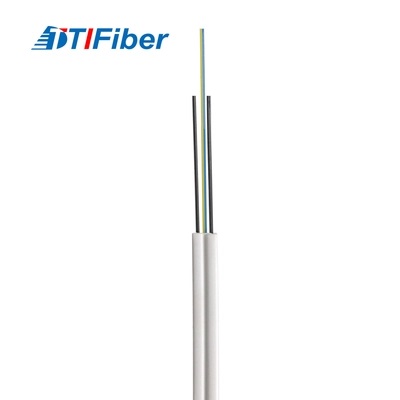
- Indoor: PVC or LSZH for fire safety; soft and flexible.
- Direct burial: Polyethylene (PE)—specifically black UV-stabilized PE—which resists:
- Soil abrasion
- Microbial degradation
- UV exposure (for above-ground segments)
- Extreme temperatures (-40°C to +70°C)
PE is tougher but less fire-safe—which is why it’s prohibited indoors unless transitioned properly.
Can You Use Direct Burial Cable Indoors—or Vice Versa?
Technically yes—but legally and safely, almost never.
Using Direct Burial Cable Indoors:
- Problem: Polyethylene jackets emit toxic fumes when burned and produce dense smoke—violating fire codes (NEC OFNR/OFNP ratings).
- Exception: Some manufacturers offer dual-rated cables (e.g., “burial-to-building” types) with a PE outer jacket and an inner fire-rated layer. These can transition from outside to inside without splicing—but they’re specialty products, not standard burial cable.
Using Indoor Cable Underground:
- Problem: No water blocking, no armor, no rodent protection. Moisture wicks through the cable via capillary action, causing hydrogen darkening and permanent attenuation increase. Rodents easily chew through soft jackets.
- Result: Failures within months, especially in humid or temperate climates.
Best practice: splice or terminate at the building entrance. Run direct burial cable to a pedestal or wall box, then transition to indoor-rated cable inside.
What About Aerial Cable—Is That the Same as Direct Burial?
No—aerial and direct burial cables solve different problems, though some hybrid designs exist.
-
Aerial cable is designed for tension and wind loading, not ground pressure. It often includes:
- A messenger wire (steel strand) for lashing to poles
- Lightweight construction to reduce sag
- UV-resistant jacket (but not necessarily rodent-proof)
-
Direct burial cable prioritizes crush resistance and water sealing, not tensile strength over spans.
That said, figure-8 cable combines both: a self-supporting aerial design with a messenger bonded to the cable—sometimes rated for temporary burial, but not long-term direct burial.
True direct burial cable lacks a messenger and is too heavy for aerial use without support.
How Do Installation Practices Differ Between the Two?
Installation isn’t just about pulling—it’s about preserving the cable’s engineered integrity.
For Direct Burial:
- Trench depth: Typically 36–48 inches (90–120 cm) to avoid frost heave and surface disturbances.
- Bedding: Sand or fine soil is placed under and over the cable to cushion against sharp rocks.
- Warning tape: Buried 12 inches above the cable to alert future excavators.
- Pulling tension: Must stay below the cable’s rated limit (often monitored with dynamometers).
- Bend radius: Never less than 20× cable diameter during install.
For Indoor Cable:
- Pathways: Installed in conduits, trays, or plenums with gentle bends.
- Fire stops: Required at floor penetrations.
- No tensile load: Supported every 5 feet; never pulled taut.
Mistaking these practices—like dragging burial cable through sharp conduit edges or coiling indoor cable in a wet vault—leads to hidden damage that manifests months later as intermittent errors or complete breaks.
Are There Different Types of Direct Burial Cable for Different Environments?
Absolutely. Not all underground conditions are equal, and cable designs reflect that:
| Environment | Recommended Cable Type | Key Features |
|---|---|---|
| Standard urban/suburban | Single-armored, gel-filled | CST armor, PE jacket, water-blocking gel |
| Rodent-prone rural areas | Double-armored or rodent-resistant | Interlocking metal armor, harder polymer layers |
| Rocky or high-crush zones | Extra-thick PE jacket + central steel wire | Enhanced crush resistance (>3,000 N/10 cm) |
| Submersible/wetlands | Fully flooded, hermetically sealed | Aluminum moisture barrier, no air gaps |
| High-voltage corridors | All-dielectric (no metal)** | Non-conductive strength members (FRP), avoids induced currents |
Choosing the wrong variant—like using standard burial cable in a gopher-infested field—can result in repeated outages and costly re-lays.
Does Direct Burial Cable Cost More—and Is It Worth It?
Yes, direct burial cable typically costs 20–50% more than equivalent indoor cable, due to armor, water-blocking materials, and ruggedized construction.
But consider the alternative:
- A failed buried indoor cable requires trenching, splicing, and service restoration—costing thousands per incident.
- Direct burial cable, properly installed, can last 30–40 years with zero maintenance.
In lifecycle cost analysis, the premium pays for itself many times over. As one utility engineer put it: “You don’t save money by burying cheap cable—you just postpone the bill.”
It’s Not Just Cable—It’s Context
The difference between direct burial and regular fiber optic cable isn’t about optics—it’s about respect for the environment. Light travels the same way in both, but the journey matters. One is built for the quiet safety of a data closet; the other for the raw, unpredictable reality of the earth itself.
Choosing correctly isn’t engineering pedantry—it’s stewardship. Because once that cable is buried, you won’t see it again for decades. And when the rain falls, the frost heaves, or the mole digs, only the right design will keep the light flowing—silently, reliably, and without compromise.


Why Can Not Indoor Cable Survive Underground
What Happens If a Single ONT Fails
Related Article