Key Technical Differences Between OS1 and OS2
Comparison Between OS1 and OS2 SMF Cables: What’s the Real Difference—and Why It Matters
In fiber optic specifications, few designations cause more confusion—or carry more consequence—than OS1 and OS2. Both are standardized categories for single-mode fiber (SMF), both use the same 9/125 µm core/cladding dimensions, and both support high-speed, long-distance transmission. Yet they are not interchangeable. Choosing the wrong one can lead to unexpected loss, failed certifications, or costly rework—especially in modern high-bandwidth or wavelength-division multiplexing (WDM) systems.
So what truly separates OS1 from OS2? Is it just a legacy label, or does it reflect fundamental differences in performance, application, and future readiness?
Let’s dissect these two standards with technical precision, historical context, and practical guidance—so you can specify with confidence, not guesswork.
What Do “OS1” and “OS2” Actually Stand For?
OS stands for “Optical Single-mode”, as defined by international cabling standards:
- OS1: Defined in ISO/IEC 11801 (Edition 1, 2002) and TIA/EIA-568-B.3 as a single-mode fiber for indoor (premises) applications.
- OS2: Introduced in ISO/IEC 11801 (Edition 2, 2008) and aligned with ITU-T G.652.D for universal (indoor + outdoor) use, including long-haul and WDM systems.
Despite similar names, OS1 and OS2 represent different generations of single-mode fiber philosophy—one optimized for controlled environments, the other for global scalability.
What Are the Key Technical Differences Between OS1 and OS2?
While both comply with ITU-T G.652 (the foundational standard for standard single-mode fiber), their performance envelopes differ significantly:
| Parameter | OS1 | OS2 |
|---|---|---|
| Maximum Attenuation | ≤1.0 dB/km @ 1310 nm ≤1.0 dB/km @ 1550 nm |
≤0.4 dB/km @ 1310 nm ≤0.3 dB/km @ 1550 nm |
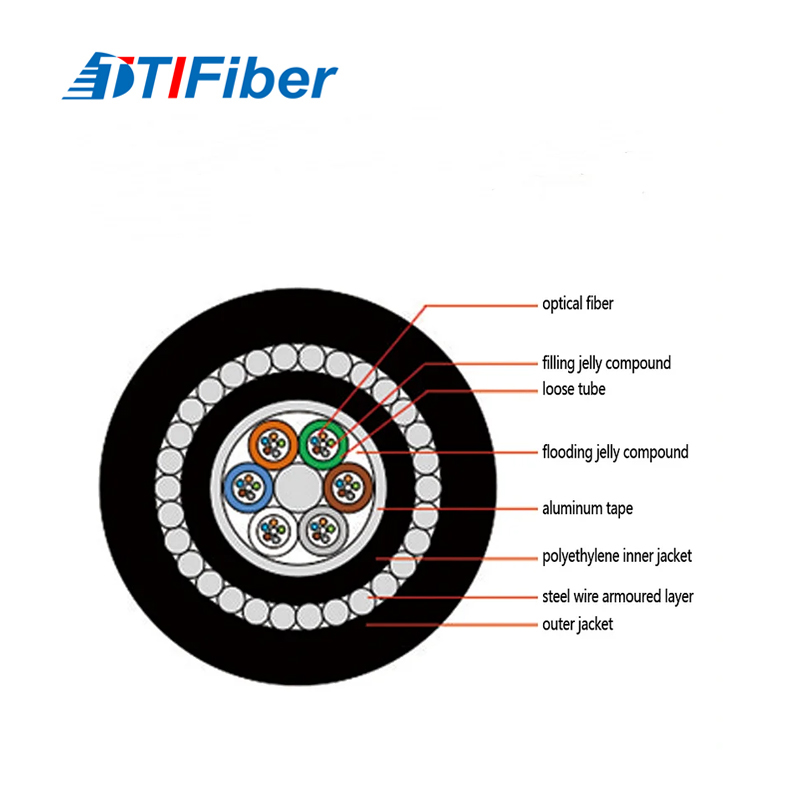
| Cable Type | Tight-buffered (indoor only) | Loose-tube or tight-buffered (indoor/outdoor) |
| Water Peak | May exhibit OH⁻ absorption peak near 1383 nm | Low Water Peak (LWP) – compliant with G.652.D |
| Operating Wavelength Range | 1310/1550 nm only | Full spectrum: 1260–1625 nm |
| Typical Use Case | Short indoor links (<10 km) | Long-haul, metro, FTTH, CWDM/DWDM |
The most critical distinction is attenuation at 1550 nm and the presence of the “water peak.”
- OS1 may have higher loss at 1550 nm and significant absorption around 1383 nm due to residual hydroxyl (OH⁻) ions from manufacturing—making the E-band (1360–1460 nm) unusable.
- OS2 is low-water-peak fiber (LWP), suppressing the 1383 nm peak to <0.31 dB/km, thereby opening the full O-, E-, S-, C-, and L-bands for transmission.
This isn’t just theoretical—it directly impacts CWDM system design, where channels span 1270–1610 nm.
Why Does the “Water Peak” Matter in Real-World Deployments?
The water peak refers to a spike in attenuation around 1383 nm caused by OH⁻ ion contamination during fiber drawing. In older fibers (including some OS1), this peak can exceed 1.0 dB/km, effectively blocking the entire E-band.
Consequence: A CWDM system using 18 channels (1271–1611 nm) will suffer complete failure on channels near 1390–1410 nm if deployed over OS1 fiber—even if the link passes 1310/1550 nm testing.
OS2 eliminates this risk by meeting ITU-T G.652.D, which mandates:
- Attenuation ≤0.31 dB/km at 1383 nm
- Full spectral continuity from 1260 to 1625 nm
For any network planning wavelength expansion, future upgrades, or dense channel spacing, OS2 isn’t optional—it’s essential.
Can OS1 and OS2 Be Spliced or Connected Together?
Yes—but with caveats.
Since both are G.652-compliant (OS1 typically meets G.652.A/B; OS2 meets G.652.D), their mode field diameters (MFD) are closely matched (~9.2 µm @ 1310 nm). This means:
- Intrinsic splice loss between OS1 and OS2 is typically <0.05 dB—negligible in most links.
- Connectors will mate without issue (same 9/125 geometry).
However, system-level risks remain:
- If the OS1 segment has a high water peak, E-band channels will fail even if the rest of the link is OS2.
- Attenuation budget calculations must use the worst-case fiber (e.g., 1.0 dB/km if OS1 is present).
Best practice: Avoid mixing unless absolutely necessary—and never use OS1 in a WDM path.
Where Should You Use OS1 vs. OS2 in Modern Networks?
OS1: Limited, Legacy-Focused Applications
- Short indoor backbone links (<2 km) in enterprise buildings where only 1310/1550 nm is used.
- Budget-constrained retrofits where existing OS1 cable is reused for 1G/10G Ethernet.
- Non-WDM environments with no plans for spectral expansion.
⚠️ Caution: Most new OS1-labeled cable is actually G.652.D—but verify with test data. True OS1 is increasingly rare.
OS2: The Universal Standard for New Deployments
- All outside plant (OSP): aerial, direct burial, duct installations.
- FTTH/PON networks: GPON, XGS-PON operate at 1490/1577 nm—within OS2’s low-loss window.
- Data center interconnects (DCI): Even short SMF links benefit from OS2’s future-proofing.
- CWDM/DWDM systems: Requires full-spectrum transparency.
- Any link >10 km: Lower attenuation at 1550 nm extends reach significantly.
In fact, major standards bodies now treat OS2 as the default. ISO/IEC 11801:2017 effectively deprecates OS1 for new installations.
How Do Installation and Testing Practices Differ?
Surprisingly little—both use the same connectors (LC, SC), splicing techniques, and cleaning protocols. But testing must account for spectral performance:
- For OS1: Validate only at 1310/1550 nm (per TIA-526-14).
- For OS2: Perform full-spectrum OTDR traces (1260–1650 nm) if WDM is planned.
- Critical Test: Measure attenuation at 1383 nm—if >0.35 dB/km, the fiber isn’t true OS2/G.652.D.
Also, OS2 loose-tube cables require gel cleanup or dry-block technology handling—unlike tight-buffered OS1—but this is a cable construction difference, not a fiber one.
Is OS1 Still Being Manufactured—and Should You Buy It?
Most major manufacturers (Corning, OFS, Prysmian) no longer produce true OS1 fiber. What’s sold as “OS1” today is often G.652.D fiber in tight-buffered indoor cable—technically OS2-grade but labeled OS1 for legacy compatibility.
However, never assume. Always demand:
- Fiber CoC (Certificate of Conformance) showing ITU-T G.652.D compliance
- Attenuation values at 1383 nm and 1550 nm
- Water peak test data
If a vendor can’t provide this, walk away. The $0.05/m savings isn’t worth a stranded network.
What About Bend-Insensitive Variants—Do They Fall Under OS1 or OS2?
Bend-insensitive single-mode fibers (e.g., ITU-T G.657.A1/A2) are subsets of G.652.D and thus classified as OS2. They offer:
- Compatibility with OS2 systems
- Enhanced bend tolerance (down to 5–7.5 mm radius)
- Same low-water-peak performance
G.657.A1 is fully compatible with G.652.D; G.657.A2 offers tighter bends but may require mode-field adapters when spliced to legacy fiber.
These are not OS1—they represent the evolution of OS2 for dense environments like MDUs or data centers.
Is the OS1/OS2 Divide Just About Loss—Or About Vision?
At its core, the difference between OS1 and OS2 reflects a shift in network philosophy:
- OS1 assumes a static, narrowband future—where 1310/1550 nm is all you’ll ever need.
- OS2 assumes an evolving, spectral-rich future—where every nanometer of bandwidth matters.
In an era of 5G fronthaul, 800G coherent pluggables, and open optical line systems, bandwidth isn’t just capacity—it’s optionality. OS2 preserves that optionality; OS1 surrenders it.
So while OS1 may suffice for a simple point-to-point link today, OS2 ensures your fiber won’t become obsolete tomorrow.
And in infrastructure that lasts 20+ years, that’s not just engineering—it’s foresight made physical.


OS2 vs OM4 Fiber Cable
OS1 vs OS2 Single-Mode Fiber
Related Article