OS1 vs OS2 Single-Mode Fiber
OS1 vs OS2 Single-Mode Fiber: What’s the Real Difference—and Which One Should You Choose?
In the world of fiber optic infrastructure, not all single-mode fibers are created equal. Beneath the surface of seemingly identical 9/125 µm glass lies a critical distinction that shapes everything from network reach and signal integrity to installation method and total cost of ownership: OS1 versus OS2.
While both fall under the ITU-T G.652 family and carry light over long distances, they were engineered for fundamentally different environments and performance expectations. Confusing them—or worse, mixing them—can lead to unexpected loss, limited scalability, or premature obsolescence.
So what truly separates OS1 from OS2? Is it just about indoor versus outdoor use? And in an era of 400G coherent optics and dense wavelength multiplexing, does OS1 still have a place?
Let’s go beyond marketing summaries and examine OS1 and OS2 through the lens of standards, physics, real-world deployment, and future-proofing—so you can specify with confidence, not guesswork.
What Do “OS1” and “OS2” Actually Mean—and Where Did These Terms Come From?
“OS” stands for Optical Single-mode, and the numbering originates from the ISO/IEC 11801 structured cabling standard, which classifies single-mode fibers by performance envelope:
- OS1: Defined for legacy indoor applications, aligned with early ITU-T G.652A/B specifications.
- OS2: Defined for modern high-performance and outdoor use, aligned with low-water-peak variants G.652C/D and, increasingly, bend-insensitive G.657.A1.
Importantly, OS1 and OS2 are not fiber types per se—they are cable performance categories. The underlying glass may be similar (often G.652.D), but the cable construction, attenuation limits, and intended use cases differ significantly.
This distinction matters because you cannot assume interchangeability—even if both cables use “single-mode” fiber.
How Do Their Technical Specifications Really Compare?
While many sources cite simplified tables, the true differences lie in nuanced engineering choices:
| Parameter | OS1 | OS2 |
|---|---|---|
| ITU-T Compliance | G.652A, G.652B (conventional); sometimes G.652C/D | G.652C, G.652D (low-water-peak); often G.657.A1 (bend-insensitive) |
| Water Peak at 1383 nm | May be present (in G.652A/B) | Suppressed (<0.31 dB/km)—enables full spectrum use |
| Max Attenuation | ≤1.0 dB/km @ 1310/1550 nm | ≤0.4 dB/km @ 1310/1550 nm |
| Typical Construction | Tight-buffered (900 µm coated fibers) | Loose-tube (250 µm fibers in gel-filled or dry tubes) |
| Primary Application | Indoor (risers, horizontal runs, data centers) | Outdoor (aerial, direct burial, OSP), universal plant |
| Max Distance (10G) | ~10 km | Up to 200 km (with appropriate optics) |
| CWDM Support | Limited (if water peak present) | Full C+L band support (1270–1610 nm) |
| Bend Radius | Standard (~30 mm) | Often enhanced (G.657.A1: 10 mm short-term) |
Key Insight: OS2 isn’t just “better”—it’s optimized for spectral efficiency, lower loss, and environmental resilience.
Why Does Cable Construction Matter More Than the Fiber Itself?
Because how you package the fiber determines where and how it can be used.
OS1: Tight-Buffered for Indoor Flexibility
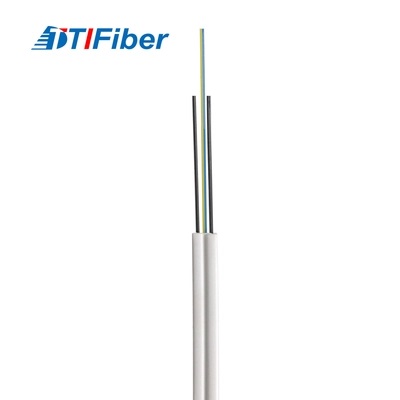
- Each fiber is coated with a 900 µm thick plastic buffer, making it robust enough for direct termination without breakout kits.
- Bundled with aramid yarn strength members inside a flame-retardant PVC or LSZH jacket.
- Ideal for patch panels, equipment racks, and intra-building runs where frequent handling and tight bends occur.
- Not designed for moisture or temperature extremes—no water-blocking elements.
OS2: Loose-Tube for Outdoor Endurance
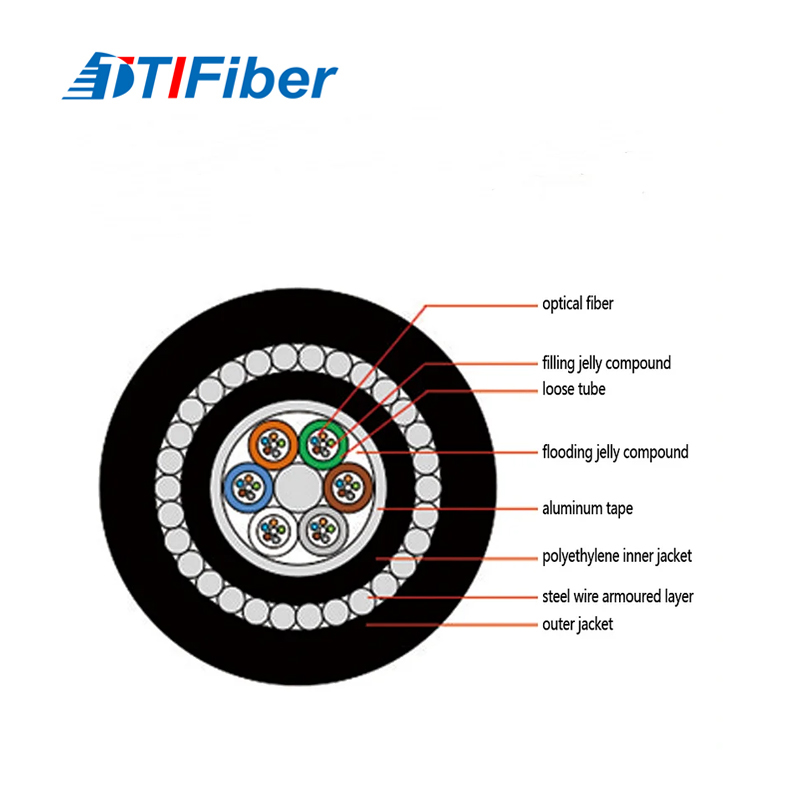
- Fibers remain in their 250 µm primary coating, housed in semi-rigid buffer tubes filled with water-blocking gel or dry SAP (superabsorbent polymer).
- Tubes are stranded around a central FRP (fiberglass) strength member, then jacketed in UV-resistant polyethylene.
- The loose-tube design allows fibers to move independently during thermal expansion or cable stretch—preventing microbending loss.
- Built for decades of burial, aerial exposure, or conduit installation.
⚠️ Critical Note: You can get loose-tube OS2 rated for indoor/outdoor use (with OFNR/OFNP jackets), but tight-buffered OS1 should never be used outdoors—it lacks moisture protection and will fail prematurely.
Can You Mix OS1 and OS2 in the Same Link?
Technically, yes—if both use G.652.D fiber. But practically, it’s strongly discouraged.
Why?
- Different mode field diameters (MFD): Even within G.652.D, manufacturing tolerances can cause MFD mismatch between vendors or cable types, leading to intrinsic splice loss (0.05–0.2 dB per joint).
- Attenuation disparity: A 10-km link mixing OS1 (1.0 dB/km) and OS2 (0.4 dB/km) creates unpredictable power budgets.
- Future incompatibility: If your OS1 segment uses G.652B (with water peak), CWDM channels near 1383 nm will suffer high loss—breaking the entire multiplexed signal.
Best practice: Maintain consistency across the entire optical path. If upgrading, replace end-to-end—not piecemeal.
When Should You Choose OS1 Over OS2—Does OS1 Still Have a Role?
Yes—but only in specific, constrained scenarios:
✅ Choose OS1 if:
- Deploying short-reach indoor links (<2 km) in enterprise buildings or data centers.
- Using legacy equipment that doesn’t require CWDM or ultra-low loss.
- Budget is extremely tight, and transceivers are already SMF-compatible.
- Need direct connectorization without fan-out splicing (tight-buffer advantage).
❌ Avoid OS1 if:
- Planning any CWDM/DWDM deployment.
- Distances exceed 5–10 km.
- Future upgrades to 25G+, 100G, or coherent optics are anticipated.
- Installing in any outdoor or harsh environment.
In reality, OS2 has become the de facto standard for new deployments—even indoors—because:
- Price difference is now minimal (<10–15% premium).
- G.652.D/G.657.A1 OS2 offers backward compatibility with all SMF optics.
- It provides headroom for unforeseen bandwidth demands.
As one Tier-1 carrier engineer put it: “We stopped specifying OS1 in 2015. There’s no reason to limit your network’s future.”
How Do Standards Like G.652 and G.657 Fit Into This Picture?
Think of ITU-T standards as the fiber’s DNA, while OS1/OS2 define the cable’s body:
- G.652A/B: Conventional SMF—higher water peak, suitable only for 1310/1550 nm.
- G.652C/D: Low-water-peak SMF—enables full 1260–1625 nm spectrum (CWDM).
- G.657.A1: Bend-insensitive SMF—compatible with G.652.D but survives 10 mm bends.
OS1 cables may use G.652A/B/C/D—but are typically G.652A/B in practice.
OS2 cables must use G.652C/D (per ISO/IEC 11801), and increasingly include G.657.A1 for dense installations.
🔍 Pro Tip: Always request the fiber specification sheet, not just “OS2.” A true G.652.D OS2 cable supports CWDM; a G.652B “OS2-labeled” cable does not.
What About Testing and Certification—Do They Differ?
Yes. Field validation must account for construction:
-
OS1 (tight-buffered):
- Test with standard LSPM (light source/power meter) or OTDR.
- No special considerations—behaves like a solid-core cable.
-
OS2 (loose-tube):
- OTDR is preferred to verify splice loss and detect macrobends.
- For CWDM systems, validate attenuation across 1260–1625 nm, not just 1310/1550 nm.
- Check for gel contamination during splicing (use dry-wipe cleaners).
Never assume “single-mode = same test profile.” The cable type dictates your verification strategy.
Is This Just About Loss—or About Longevity?
Choosing between OS1 and OS2 isn’t merely a question of current reach or cost. It’s a commitment to your network’s lifespan.
OS1 reflects an era when 10 km was “long-haul” and CWDM was exotic. OS2 reflects today’s reality: exponential bandwidth growth, spectral efficiency, and infrastructure that must last 20+ years.
In that context, OS2 isn’t an upgrade—it’s the baseline. And OS1? A legacy artifact, useful only where the future is deliberately ignored.
So ask not just “What works today?” but “What will carry us tomorrow?”
The answer, more often than not, is OS2.


Key Technical Differences Between OS1 and OS2
What Is Pre-Terminated Armored Fiber Optic Cable
Related Article