Verify the Quality of Raw Materials Before Purchasing Armored Fiber Optic Cable
How Do You Verify the Quality of Raw Materials Before Purchasing Armored Fiber Optic Cable?
When investing in armored fiber optic cable for critical infrastructure—whether for direct burial in remote terrain, installation in industrial facilities, or deployment in high-risk urban corridors—the stakes are high. A substandard cable may pass initial continuity tests but fail prematurely due to corrosion, water ingress, fiber degradation, or mechanical fatigue. Since you can’t X-ray every reel on delivery, proactive verification before purchase is essential.
But how do you look beyond glossy datasheets and marketing claims to confirm that the raw materials inside truly meet engineering-grade standards? The answer lies in a disciplined, evidence-based approach that combines documentation review, third-party validation, and material traceability.
Let’s explore the practical, field-tested methods professionals use to verify raw material quality—before a single meter is pulled.
Why Can’t You Rely on Visual Inspection or Brand Name Alone?
Because failure hides beneath the surface.
- Armor may look intact, but thin or poorly galvanized steel will corrode from within after moisture penetrates a jacket nick.
- Jackets may feel tough, but recycled polyethylene without UV stabilizers embrittles in 2–3 years under sunlight.
- Fibers may transmit light, but off-brand glass with high OH⁻ content develops “water peak” loss over time, especially at 1383 nm.
- A well-known brand name doesn’t guarantee consistency across global manufacturing sites or subcontractors.
Visual checks confirm gross defects—not material integrity. Trust must be earned through data, not appearance.
What Core Documentation Should You Demand from the Manufacturer?
Insist on lot-specific, test-backed documentation—not generic brochures. Key documents include:
1. Fiber Certificate of Conformance (CoC)
- Must specify:
- Fiber manufacturer (e.g., Corning, OFS, Yangtze Optical)
- ITU-T compliance (e.g., G.652.D, G.657.A1)
- Attenuation values at 1310 nm, 1550 nm, and 1625 nm
- Proof of hydrogen aging resistance (per Telcordia GR-20)
Red flag: Vague statements like “meets G.652” without measured attenuation or manufacturer name.
2. Armor Material Certification
- For corrugated steel tape (CST):
- ASTM A641 compliance (zinc coating mass ≥275 g/m²)
- Tensile strength and elongation data
- Salt spray test results (ASTM B117) showing ≥500 hours to white rust
- For interlocking aluminum:
- ASTM B317 alloy specification
- Seam overlap dimension verification
Red flag: No mention of coating type or thickness—galvanization is non-negotiable for buried steel.
3. Jacket Material Test Reports
- Outdoor PE jacket:
- ASTM D4568 UV resistance test (retained tensile strength after 1,000+ hours)
- Carbon black content ≥2.5% (verified via thermogravimetric analysis)
- Indoor LSZH jacket:
- IEC 60754-2: Acid gas emission <5 mg/g
- IEC 61034-2: Smoke density >60%
- UL 910 (plenum) or UL 1685 (riser) flame test certification
Red flag: Claiming “LSZH” without IEC 60754/61034 reports—many cables use halogenated flame retardants illegally labeled as LSZH.
4. Water-Blocking System Validation
- Request water penetration test video or report per IEC 60794-1-E1:
- 1-meter cable sample submerged for 24 hours
- Water migration ≤1 meter (premium: ≤0.5 m)
- Confirm use of superabsorbent polymer (SAP) tapes, not just gel
Red flag: No water-blocking data—armor stops punctures, not capillary action.
Which Third-Party Certifications Are Non-Negotiable?
Independent lab validation separates credible suppliers from opportunists. Require certificates from recognized bodies:
| Test | Standard | Purpose |
|---|---|---|
| Flame & Smoke | UL 910, UL 1685, IEC 60332-3 | Fire safety for indoor use |
| Low Toxicity | IEC 60754-1/2 | Halogen/acid gas emission |
| Smoke Density | IEC 61034-2 | Visibility during fire |
| UV Resistance | ASTM D4568, ISO 4892-2 | Outdoor jacket longevity |
| Corrosion Resistance | ASTM B117 (salt spray) | Armor durability in humid/coastal areas |
| Mechanical Performance | IEC 60794-1-E3 (crush), E4 (impact) | Crush/impact resilience |
Look for certification marks (UL, TÜV, Intertek, CSA) on test reports—not just “tested per.”
How Do You Verify Material Traceability and Lot Consistency?
Quality isn’t batch-limited—it’s lot-controlled. Ask:
- Is raw material traceable to source? (e.g., steel coil number, fiber preform batch)
- Does the manufacturer perform incoming inspection on all raw materials?
- Can they provide test data for the specific lot you’re purchasing?
Reputable manufacturers use ERP systems that link purchase orders to material certs, production logs, and final test results. If they can’t provide lot-specific data, assume inconsistency.
What Questions Should You Ask the Supplier Directly?
Go beyond paperwork with targeted inquiries:
-
“Who supplies your optical fiber?”
→ Accept only Tier-1 names (Corning, OFS, Fujikura, Yangtze). Avoid “proprietary” or unnamed sources. -
“Is your steel armor hot-dip galvanized or electro-galvanized?”
→ Hot-dip (ASTM A641) is required for burial; electro-galvanized lacks sufficient zinc thickness. -
“Do you use dry water-blocking or gel-filled tubes?”
→ Dry (SAP) is preferred for modern installations—cleaner, faster splicing. -
“Can you provide a cross-section photo of your cable?”
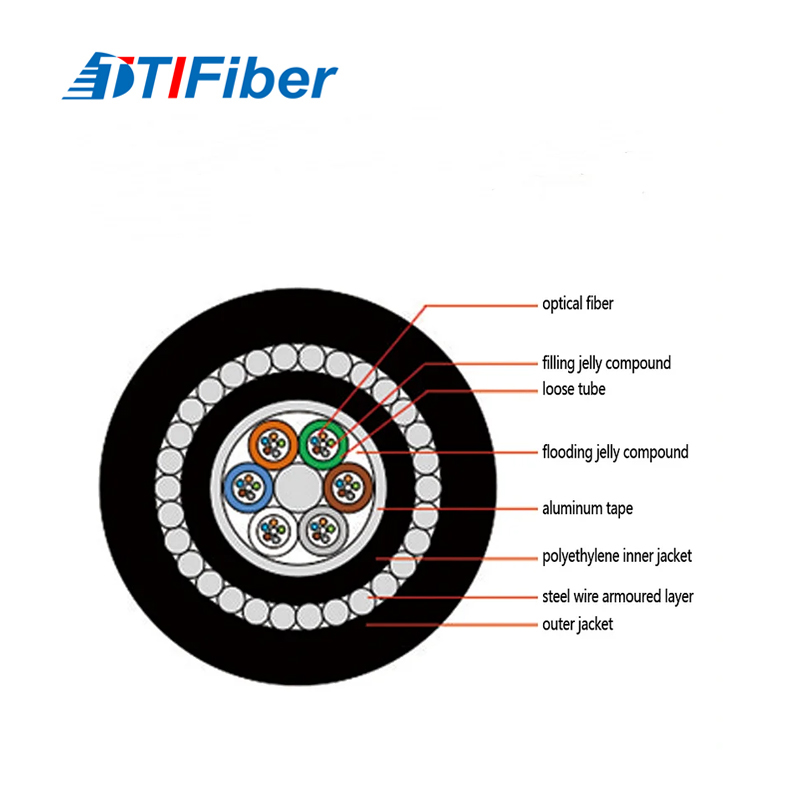
→ Reveals armor uniformity, APL sheath coverage, and core construction. -
“Have you deployed this exact cable design in [your environment] before?”
→ Field history matters more than lab tests.
What Are the Costliest Mistakes Buyers Make When Verifying Quality?
- Accepting “equivalent to” claims without test proof.
- Skipping water-blocking validation—the #1 cause of long-term failure in armored cables.
- Assuming all “G.652.D” fiber is equal—attenuation and geometry vary widely.
- Ignoring jacket formulation—UV and fire performance are make-or-break.
- Purchasing based on price alone—a $0.10/m savings can cost $10,000 in future outages.
Remember: You’re not buying cable—you’re buying decades of reliability.
Is Verification Just Due Diligence—or Strategic Risk Management?
Verifying raw material quality isn’t bureaucratic overhead. It’s engineering foresight. Every document you request, every test you demand, every question you ask builds a chain of accountability that protects your network long after installation crews have left.
In critical infrastructure, there are no second chances. The time to verify quality isn’t when the cable fails—it’s before it arrives.
Because the best armored cable doesn’t just survive the elements. It earns your trust—one certified micron at a time.


What Is SWA Fiber Optic Cable
The Core Structural Layers of an Unarmored Fiber Optic Cable
Related Article