What Is Pre-Terminated Armored Fiber Optic Cable
What Is Pre-Terminated Armored Fiber Optic Cable?
In today’s race to deploy high-speed networks faster, cleaner, and with fewer field errors, a quiet revolution has taken place in fiber optic cabling: the rise of pre-terminated solutions. Among the most robust of these is pre-terminated armored fiber optic cable—a factory-built assembly that combines the mechanical resilience of metallic armor with the precision of factory-polished connectors.
But what exactly defines this product? Is it simply an armored cable with plugs on the ends—or is there deeper engineering value in its design? And when does it make strategic sense to choose pre-terminated armored over traditional field-terminated alternatives?
Let’s move beyond the surface and explore how this hybrid solution merges industrial toughness with data-center-grade reliability—transforming deployment economics, quality control, and long-term network performance.
What Exactly Is “Pre-Terminated Armored Fiber Optic Cable”?
Pre-terminated armored fiber optic cable is a factory-assembled, end-to-end optical link that integrates three critical elements into a single, tested unit:
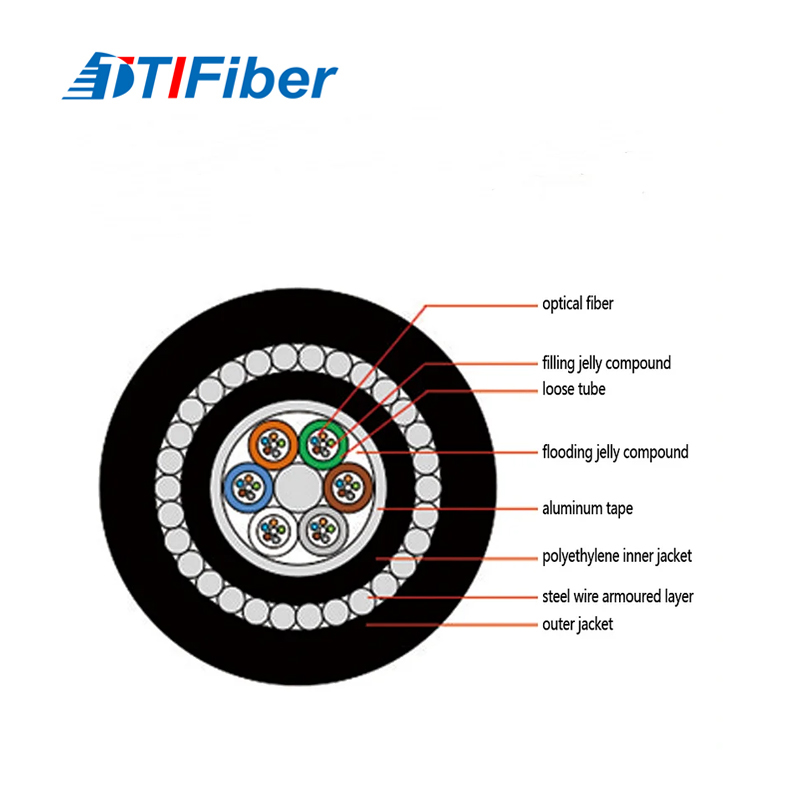
- Armored Cable Core: Typically featuring corrugated steel tape (CST), interlocking steel/aluminum armor, or steel wire armor (SWA) for crush, rodent, and impact resistance.
- Factory-Terminated Connectors: High-precision connectors (LC, SC, MPO, etc.) polished and inspected under controlled conditions—often with ceramic ferrules and ultra-low reflectance.
- Strain-Relief and Sealed Boots: Robust connector housings with integrated strain relief and, in outdoor variants, IP67/IP68-rated sealing against moisture and dust.
Unlike traditional installations—where cable is pulled first and connectors are spliced or terminated in the field—pre-terminated armored cable arrives ready to plug in, with every component validated before shipment.
This approach shifts the point of quality assurance from the unpredictable field to the repeatable factory environment—a shift with profound implications for performance and reliability.
Why Combine Armor with Pre-Termination? Isn’t That Overkill?
Not at all. The combination solves a specific set of real-world challenges where both environmental harshness and connector integrity matter:
- Industrial Facilities: Factories, oil rigs, and power plants demand armor for physical protection—and pre-termination ensures connectors survive vibration, temperature swings, and chemical exposure without field-splice failures.
- Outdoor Enclosure Links: Connections between handholes, pedestals, or cell towers often require direct burial or aerial exposure (armor) plus rapid, reliable mating (pre-terminated).
- Military & Transportation: Railways, airports, and defense systems need ruggedized links that can be deployed quickly during outages—without relying on fusion splicers in the rain.
- Data Center Inter-Building Runs: When linking buildings across campus, pre-terminated armored cables eliminate splice points, reducing loss and failure risk.
In these scenarios, armor protects the cable body, while factory termination protects the most vulnerable part of any fiber link: the connector.
How Does Factory Termination Improve Performance Over Field Methods?
The difference isn’t marginal—it’s transformative. Consider these key advantages:
1. Consistent Insertion Loss and Reflectance
- Factory polishing achieves ≤0.2 dB insertion loss and ≥−55 dB return loss (UPC) or ≥−65 dB (APC)—consistently across every connector.
- Field terminations often vary between 0.2–0.75 dB due to dust, humidity, or technician skill—eroding precious link budget.
2. Zero Contamination Risk
- Connectors are assembled in ISO Class 5 (Class 100) cleanrooms, then sealed in protective caps.
- Field terminations are exposed to dust, oils, and moisture—even with best practices.
3. Full Test Validation
- Every pre-terminated assembly undergoes 100% optical testing (IL/RL) and often OTDR certification.
- Field splices may be tested—but rarely with the same rigor or documentation.
4. Bend-Insensitive Fiber Integration
- Most pre-terminated cables use ITU-T G.657.A1/A2 fiber, which tolerates tight bends around corners or in enclosures—critical in dense industrial panels.
The result? A predictable, documented, and repeatable optical path—exactly what mission-critical networks demand.
What Are the Typical Construction Features of Pre-Terminated Armored Cable?
While designs vary, high-quality pre-terminated armored assemblies share these traits:
- Fiber Type: G.652.D or G.657.A1/A2 single-mode; OM4/OM5 multimode for short-reach industrial links.
- Armor Type:
- Indoor/Outdoor: Interlocking aluminum or steel armor with LSZH jacket.
- Direct Burial: Corrugated steel tape (CST) or SWA with black PE jacket.
- Connector Options: Duplex LC/SC for point-to-point; MPO/MTP for parallel optics (e.g., 40G/100G).
- Sealing: IP67/IP68-rated connector boots with O-rings or gel seals for outdoor use.
- Length Precision: Custom-cut to exact run lengths (e.g., 15.3 m)—minimizing slack and coiling loss.
- Pulling Grip: Integrated Kevlar® or aramid yarn strain relief bonded to the connector backshell.
Crucially, the armor is electrically continuous to the connector housing—enabling proper grounding when required (e.g., for SWA types).
How Does Installation Differ from Traditional Field-Terminated Cable?
Dramatically—and favorably:
| Task | Traditional Field-Terminated | Pre-Terminated Armored |
|---|---|---|
| Pulling | Pull bare cable, then terminate | Pull entire assembly with connectors protected in breakaway reels or pulling socks |
| Termination Time | 15–45 min per connector (splicing + polishing) | Zero—plug and test |
| Test Documentation | Often incomplete or manual | Factory-provided IL/RL report + OTDR trace per assembly |
| Skill Dependency | High—requires certified splicer | Low—basic fiber handling only |
| Failure Risk | Splice errors, contamination, polish defects | Minimal—only handling damage during pull |
Installation becomes a logistics exercise, not a craft. Teams can deploy dozens of links in a day—without fusion splicers, cleavers, or inspection scopes on-site.
What Are the Grounding Requirements for Pre-Terminated Armored Cable?
If the armor is metallic (steel or aluminum), grounding rules still apply—even with pre-terminated ends:
- SWA or CST Types: Must be grounded at both ends per NEC Article 770 and IEC 62305.
- Connector Housings: Many pre-terminated armored assemblies feature grounding lugs or conductive backshells that bond the armor to the enclosure’s earth point.
- AWA (Aluminum Wire Armored): Non-magnetic and corrosion-resistant—ideal for hazardous areas—but still requires bonding for lightning protection.
Never assume “pre-terminated” means “no grounding.” The armor remains conductive—and thus, a potential hazard if ungrounded.
When Should You Avoid Pre-Terminated Armored Cable?
Despite its advantages, it’s not universally ideal:
- Unpredictable Path Lengths: If final distances aren’t known, excess cable must be coiled—adding loss and clutter.
- High-Fiber-Count Backbone: For 144+ fibers, trunk-and-branch architectures with field splicing may be more economical.
- Budget-Constrained Projects: Upfront cost is 20–40% higher than field-terminated—though TCO often favors pre-terminated due to labor savings.
- Custom Connector Configurations: Rare interface types may not be available off-the-shelf.
Use pre-terminated armored when speed, reliability, and environmental protection outweigh minor cost premiums.
How Do You Verify Quality When Procuring Pre-Terminated Armored Cable?
Demand more than a catalog number:
- Test Reports: IL/RL per IEC 61300-3-4/3-6; OTDR trace for each assembly.
- Fiber Certification: G.652.D or G.657.A1 compliance with attenuation data.
- IP Rating: IP67/IP68 certification for outdoor connectors (per IEC 60529).
- Armor Type Specification: Clear identification (CST, SWA, interlocking) with material certs.
- Manufacturer Traceability: Lot numbers, build records, and warranty (typically 20–25 years).
Reputable suppliers provide individual test reports per assembly—not batch averages.
Is Pre-Terminated Armored Cable Just Convenience—or a New Standard?
Pre-terminated armored fiber optic cable represents more than a time-saver. It embodies a shift in philosophy: from trusting field craftsmanship to guaranteeing factory precision—even in the harshest environments.
In an era where networks must be deployed faster, last longer, and fail less, this hybrid solution offers the best of both worlds: the ruggedness of industrial armor and the fidelity of data-center-grade optics.
And in that balance lies not just efficiency—but confidence. Confidence that when you plug it in, the light will flow exactly as promised—because every micron was perfected before it left the factory floor.


OS1 vs OS2 Single-Mode Fiber
Does All-Dielectric Fiber Optic Cable Need Lightning Protection? | TTI Fiber
Related Article