What Is SWA Fiber Optic Cable
What Is SWA Fiber Optic Cable?
In the demanding world of industrial, utility, and outdoor fiber deployments, not all cables are created equal. When engineers specify a solution for direct burial in rocky soil, installation alongside high-voltage lines, or routing through rodent-infested terrain, they often reach for a ruggedized option known as SWA fiber optic cable.
But what exactly does “SWA” mean? Is it just another marketing term—or does it represent a specific, standardized construction with real engineering value? And how does it compare to other armored cable types like AWA or CST?
Let’s cut through the jargon and explore SWA fiber optic cable not as a label, but as a purpose-built solution shaped by British standards, field realities, and the relentless need for mechanical resilience.
What Does “SWA” Stand For—and Where Did It Originate?
SWA stands for “Steel Wire Armoured.” The term originates from British and European cable standards, particularly BS 6346 (for power cables) and its fiber optic counterpart BS EN 50173-1 / BS 7878, which define construction requirements for armored communication cables.
Unlike generic “armored” labels, SWA specifies a precise armor type: a layer of galvanized steel wires helically wound around the cable core to provide exceptional tensile strength, crush resistance, and protection against impact, digging, and animal attack.
While “armored fiber cable” is a broad category, SWA denotes a specific, high-durability subtype—commonly used in the UK, Europe, Middle East, and Commonwealth countries. In North America, similar constructions are often called “wire-armored” or “interlocked steel wire armored,” but without the standardized SWA designation.
What Is the Typical Structure of an SWA Fiber Optic Cable?
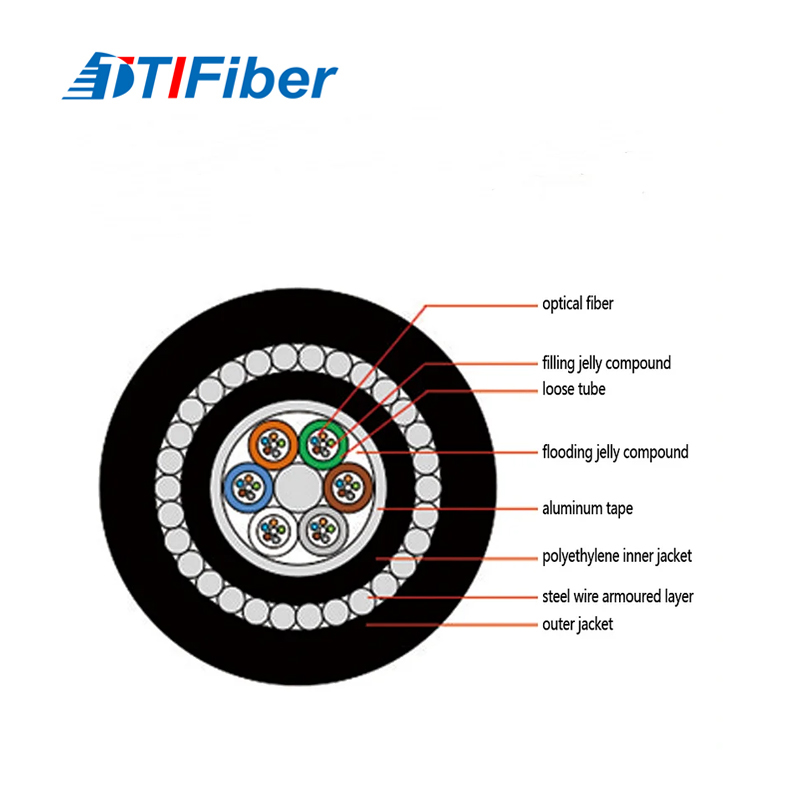
An SWA fiber cable is built like a fortress—layered, robust, and engineered for decades of service in harsh conditions. A standard outdoor SWA cable includes the following components, from center to surface:
- Optical Fibers: Usually ITU-T G.652.D single-mode or OM4 multimode fibers, each with a 250 µm acrylate coating.
- Loose Buffer Tubes: Made of PBT (polybutylene terephthalate), housing 2–12 fibers per tube, filled with water-blocking gel or dry superabsorbent polymer (SAP) tapes.
- Central Strength Member: A rigid FRP (fiberglass-reinforced plastic) or steel rod that prevents buckling and provides longitudinal stability.
- Moisture Barrier: An aluminum-polyethylene laminated (APL) sheath that blocks radial water vapor diffusion—a critical layer even when armor resists physical puncture.
- Bedding Layer: A thin extruded PVC or PE layer applied over the APL sheath to cushion the armor wires and prevent damage to the underlying layers during application.
- Steel Wire Armor (SWA): The defining feature—galvanized round steel wires (typically 0.9–2.5 mm diameter) helically wound in one or two layers. This provides:
- High tensile strength (up to 15,000 N or more)
- Crush resistance (>3,000 N/10 cm)
- Rodent and shovel penetration resistance
- Outer Sheath: A final jacket of black PVC (most common) or LSZH/PE for specific environments. The PVC sheath is UV-resistant and formulated for long-term burial.
This multi-layer design ensures that even if the outer sheath is damaged, the steel wires and APL barrier continue to protect the optical core.
How Does SWA Differ from Other Armored Cable Types Like AWA or CST?
Not all armor is equal. Key distinctions:
| Type | Armor Material | Key Properties | Typical Use |
|---|---|---|---|
| SWA (Steel Wire Armoured) | Galvanized round steel wires | Highest tensile & crush strength; excellent rodent resistance | Direct burial in rocky/industrial areas; long-span aerial (lashed); high-risk zones |
| AWA (Aluminum Wire Armoured) | Aluminum alloy wires | Lighter weight; non-magnetic; corrosion-resistant; no grounding needed | Coastal areas; explosive environments; EMI-sensitive sites |
| CST (Corrugated Steel Tape) | Thin corrugated steel tape | Good crush resistance; flexible; lower cost | Standard direct burial; conduit-less urban runs |
| Interlocking Armor | Overlapping steel/aluminum strips | Flexible; good crush resistance; easier to terminate | Indoor/outdoor transitions; industrial plants |
SWA excels where extreme mechanical threats exist—but it’s heavier, stiffer, and requires grounding (due to its conductive steel). AWA avoids grounding but offers less crush strength. CST is cost-effective for moderate threats but can’t match SWA’s tensile performance.
Why Choose SWA Over Simpler Armored Options?
SWA is selected when failure is not an option. Common scenarios include:
- Direct burial in rocky or unstable soil where point loads could crush thinner armor.
- Areas with high rodent or wildlife activity (e.g., farms, forests)—steel wires deter chewing far better than tape.
- Industrial sites with heavy vehicle traffic, forklifts, or machinery that could impact buried cables.
- Long unsupported aerial spans (when lashed to a messenger)—SWA’s tensile strength reduces sag.
- High-security or critical infrastructure (power substations, military bases) where tamper resistance is required.
In these cases, the higher cost and installation complexity of SWA are justified by decades of trouble-free operation.
What Are the Installation and Grounding Requirements for SWA Cable?
Because SWA uses conductive galvanized steel, it must be properly grounded per electrical safety codes:
- NEC (NFPA 70) Article 770: Metallic armor must be bonded to earth at both ends of the cable run to prevent voltage buildup from lightning or induction.
- IEC 62305: Requires low-impedance grounding to dissipate surge currents safely.
- Best Practice: Use exothermic welding or listed grounding clamps—not mechanical screws—to ensure permanent, low-resistance connection.
Additionally:
- Minimum bending radius: Typically 20× cable diameter during installation, 15× long-term.
- Pulling tension: Must not exceed cable’s rated tensile load (often 6,000–15,000 N).
- Termination: Requires specialized glands that clamp both the armor and inner sheath to maintain strain relief and moisture seal.
Skipping proper grounding risks equipment damage, fire, or electric shock—never treat SWA like a passive dielectric cable.
How Do You Verify the Quality of SWA Fiber Optic Cable?
As with all armored cables, material integrity matters more than appearance. Demand:
- Fiber CoC: From Tier-1 manufacturer, G.652.D compliant, attenuation ≤0.20 dB/km @ 1550 nm.
- Steel Wire Certification: ASTM A475 or BS EN 10264 for galvanized wire—zinc coating ≥300 g/m².
- Sheath Compliance: BS 7878 or IEC 60794 for mechanical/environmental performance.
- Water Penetration Test: Per IEC 60794-1-E1—<1 m migration after 24h submersion.
- Crush & Impact Reports: ≥3,000 N/10 cm crush; 10 N·m impact resistance.
Inspect for:
- Uniform wire lay and tight helix pitch
- No exposed wires at cut ends
- Smooth, crack-free PVC sheath
- Lot number and manufacturer marking
Are There Limitations or Drawbacks to Using SWA?
Yes—SWA isn’t universally ideal:
- Weight and Stiffness: Harder to pull through conduits; requires larger bend radii.
- Grounding Complexity: Adds cost and labor; prohibited in some explosive atmospheres unless specially certified.
- Corrosion Risk: In highly acidic or saline soils, even galvanized steel can degrade over decades—consider AWA or double-jacketed SWA in such cases.
- Cost: 30–60% more expensive than CST-armored cable.
Use SWA only when the threat justifies it. Over-specifying wastes resources; under-specifying risks catastrophic failure.
Is SWA Just About Toughness—or About Trust?
SWA fiber optic cable embodies a simple truth: in critical infrastructure, protection can’t be outsourced to luck. It’s chosen not for convenience, but for confidence—confidence that when a backhoe bites, a rodent gnaws, or lightning strikes, the light inside will keep flowing.
But that confidence must be earned through proper specification, installation, and grounding. Because armor alone isn’t enough. True resilience is engineered—not just wrapped in steel.
And in the end, SWA isn’t just a cable. It’s a promise—to the network, to the operator, and to everyone who depends on it—that the connection will hold, no matter what.


Does All-Dielectric Fiber Optic Cable Need Lightning Protection? | TTI Fiber
Verify the Quality of Raw Materials Before Purchasing Armored Fiber Optic Cable
Related Article