Why Can Not Indoor Cable Survive Underground
How Is Direct Burial Cable Structurally Different From Indoor or Aerial Cable?
At first glance, all fiber optic cables might appear similar—slender, flexible, and wrapped in colored jackets. But beneath the surface, their internal architectures diverge dramatically based on where they’re meant to live. A cable designed for the climate-controlled calm of a data center cannot survive the harsh reality of being buried underground any more than a tropical fish can thrive in the open ocean.
So what exactly makes direct burial fiber optic cable structurally distinct from its indoor or aerial counterparts? The answer lies not in one single feature, but in a layered defense system engineered to withstand decades of environmental assault. Let’s dissect these differences with the precision they deserve—layer by layer, function by function.
Why Can’t Indoor Cable Survive Underground—What’s Missing?
Indoor fiber optic cable is optimized for safety, flexibility, and fire performance, not durability in hostile environments. Its structure reflects this:
- Jacket: Made of PVC or LSZH (Low Smoke Zero Halogen) material—soft, pliable, and flame-retardant, but easily punctured by rocks, roots, or rodent teeth.
- Strength members: Typically aramid yarn (e.g., Kevlar®)—excellent for tensile strength during gentle pulls, but offers zero crush resistance.
- Water protection: None. Indoor cables assume dry conditions; they contain no water-blocking gels, tapes, or powders.
- Armor: Absent. There’s no metallic or composite barrier to shield the fragile glass fibers.
Bury this cable, and moisture wicks through capillary action along the buffer tubes. Within months, water reacts with glass defects, causing hydrogen darkening—a permanent increase in attenuation. Rodents gnaw through the soft jacket. Rocks crush the core. The result? Premature failure, often without visible external damage.
In short: indoor cable lacks the three pillars of underground survival—water resistance, mechanical armor, and long-term chemical stability.
What Structural Layers Make Direct Burial Cable “Battle-Ready”?
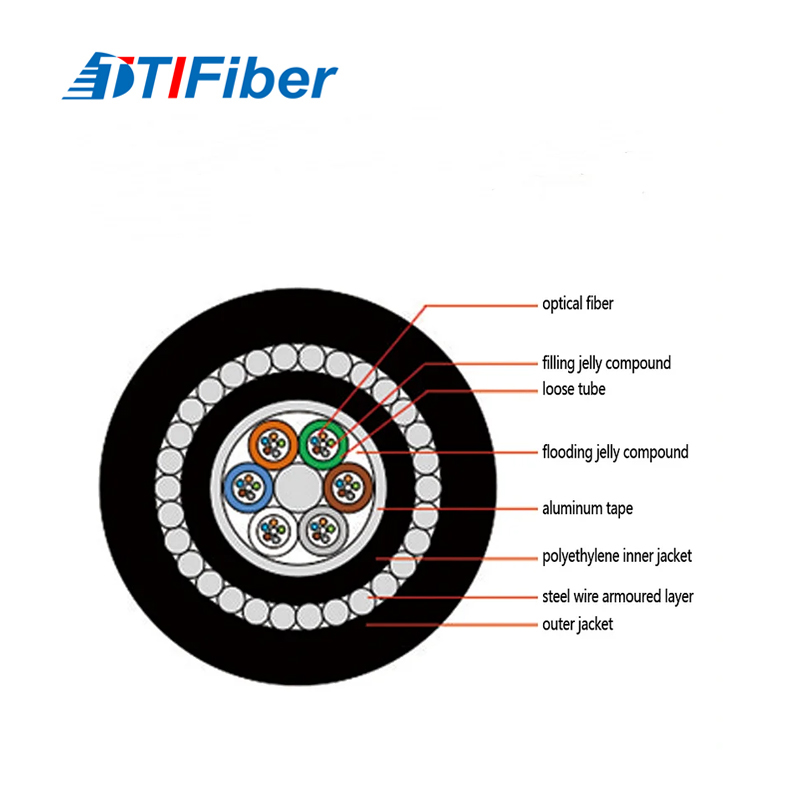
Direct burial cable is built like a submarine: sealed, armored, and pressure-resistant. Its cross-section typically includes five critical layers, each serving a distinct protective role:
1. Optical Fibers and Buffer Tubes
- Fibers reside in loose buffer tubes filled with water-blocking gel (in traditional designs) or surrounded by dry, superabsorbent polymer (SAP) tapes.
- These tubes float freely within the cable core, isolating fibers from strain and allowing thermal expansion without microbending.
2. Water-Blocking System
- Unlike indoor cable, direct burial variants deploy dual-stage moisture defense:
- Longitudinal blocking: Swellable tapes or yarns expand 10–20x upon contact with water, sealing gaps instantly.
- Radial blocking: Gel or powder prevents water from penetrating inward if the outer sheath is breached.
- This ensures that even if a backhoe nicks the cable, water won’t travel kilometers along the core.
3. Central or Stranded Strength Member
- Instead of aramid yarn, direct burial cables use a steel wire strength member—either a single central rod or stranded wires around the core.
- This provides high tensile rating (often 600–1,000 lbs), resists elongation under load, and adds rigidity to prevent kinking during pull-in.
4. Metallic Armor Layer
- The defining feature: a corrugated steel tape (CST) or interlocking aluminum armor wrapped helically around the core.
- CST: Lightweight, flexible, and cost-effective—standard for most utility and telecom deployments.
- Interlocking armor: Rigid, overlapping metal segments—used in high-risk zones (e.g., farmland, forests) for superior rodent and crush resistance.
- This armor absorbs crushing forces from rocks, soil compaction, or accidental excavation, shielding the delicate fibers inside.
5. Outer Jacket: Black Polyethylene (PE)
- The final barrier is a thick, UV-stabilized black polyethylene sheath.
- Resists abrasion, soil chemicals, microbial degradation, and temperature extremes (-40°C to +70°C).
- Contains carbon black for UV protection—critical for above-ground exposure during installation.
- Unlike indoor PVC, PE doesn’t burn cleanly—but that’s acceptable outdoors, where fire codes don’t apply.
Together, these layers form a passive, maintenance-free shield that can endure 30+ years underground with no degradation.
How Does Aerial Cable Differ Structurally—and Why Isn’t It Suitable for Burial?
Aerial cable solves a different set of problems: tension, wind sway, ice loading, and pole-to-pole spans. Its structure reflects this:
- Messenger wire: Most aerial cables include a steel messenger strand either lashed separately or bonded in a “figure-8” design. This carries the tensile load—not the fiber core.
- Lightweight construction: Minimal armor (if any), thinner jacket, and lighter strength members to reduce sag over long spans.
- UV-resistant jacket: Yes—but often made of PE or AT (anti-tracking) compounds, not fire-safe materials.
- No water-blocking: Many aerial cables are “dry” but not fully flooded; they assume brief rain exposure, not constant immersion.
While some aerial cables (like self-supporting ADSS—All-Dielectric Self-Supporting) can tolerate temporary burial, they lack crush resistance and long-term moisture sealing. Bury them, and soil pressure deforms the core, while water migrates freely—leading to signal loss or breakage.
Crucially, aerial cable is not armored against rodents or rocks. In rural areas, this is a fatal flaw.
Are There Hybrid Cables That Bridge These Categories?
Yes—but with important caveats.
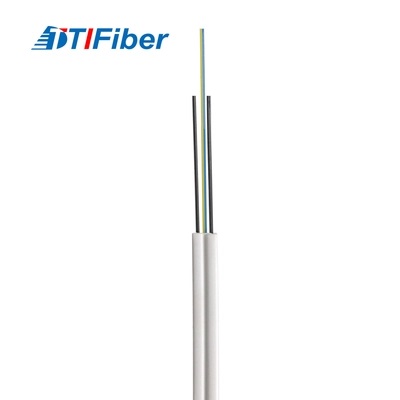
- Burial-to-building cable: Features an outer PE jacket for outdoor/direct burial use and an inner fire-rated layer (e.g., riser-rated) for indoor entry. Splicing isn’t needed at the wall penetration—ideal for FTTH drop installations.
- Armored indoor/outdoor cable: Combines LSZH indoor safety with interlocking metal armor and water-blocking—used in campus backbones crossing trenches and conduits.
- Dual-rated aerial/burial cable: Rare, but exists for temporary deployments (e.g., disaster recovery). Not recommended for permanent burial.
However, true direct burial cable is never rated for indoor use due to its PE jacket’s toxic smoke emission. Always verify NEC (or local) compliance before installation.
Does the Fiber Count or Type Affect the Structural Design?
Absolutely. Higher fiber counts demand more robust engineering:
- Low-count cables (1–12 fibers): Often use tight-buffered fibers with simpler armor—common for FTTH drops.
- High-count cables (48–864+ fibers): Use loose-tube, gel-filled designs with central steel strength members and double armor for backbone routes.
- Single-mode vs. multimode: Doesn’t change structure—but single-mode dominates outside plant (OSP) due to distance and bandwidth needs.
Moreover, microduct or blown fiber cables used in conduit-based burial have entirely different architectures—thin, smooth-jacketed, and unarmored—because the conduit provides external protection. These are not direct burial cables.
Final Thought: Structure Follows Environment
The structural differences between direct burial, indoor, and aerial fiber optic cables aren’t arbitrary—they’re direct responses to the physics of their operating environments.
Indoor cable prioritizes human safety.
Aerial cable conquers gravity and wind.
Direct burial cable wages silent war against earth, water, and time.
Choosing the right one isn’t about preference—it’s about respecting the forces your cable will face for decades. Because once it’s in the ground, you won’t get a second chance to armor it. And light, for all its speed, cannot shine through a crushed, waterlogged core.


Differences Between ACSR Conductor and ACCC Conductor
Direct Burial Fiber Optic Cable vs. Regular Fiber Optic Cable
Related Article