Why Is Armored Cable Preferred for Direct Burial Installations
Where Are Armored Cables Typically Used—and Why?
Fiber optic cables are marvels of modern engineering—capable of transmitting terabits of data across continents with minimal loss. But their glass cores are fragile, and the environments they traverse are rarely gentle. This tension between vulnerability and exposure is precisely why armored fiber optic cables exist. They’re not a universal solution, but a targeted response to specific threats: crushing forces, gnawing teeth, sharp tools, and the slow grind of time in harsh conditions.
So where exactly do these reinforced cables prove indispensable? And what makes armor not just useful—but essential—in those settings? Let’s explore the real-world scenarios where armored fiber isn’t a luxury, but a necessity.
Why Is Armored Cable Preferred for Direct Burial Installations?
When a fiber cable is buried directly in the ground—without conduit—it enters a world of unpredictable stress. Soil shifts with seasons, rocks press inward, backfill operations drop heavy debris, and tree roots slowly constrict over decades. In this environment, an unarmored cable’s plastic jacket offers little defense.
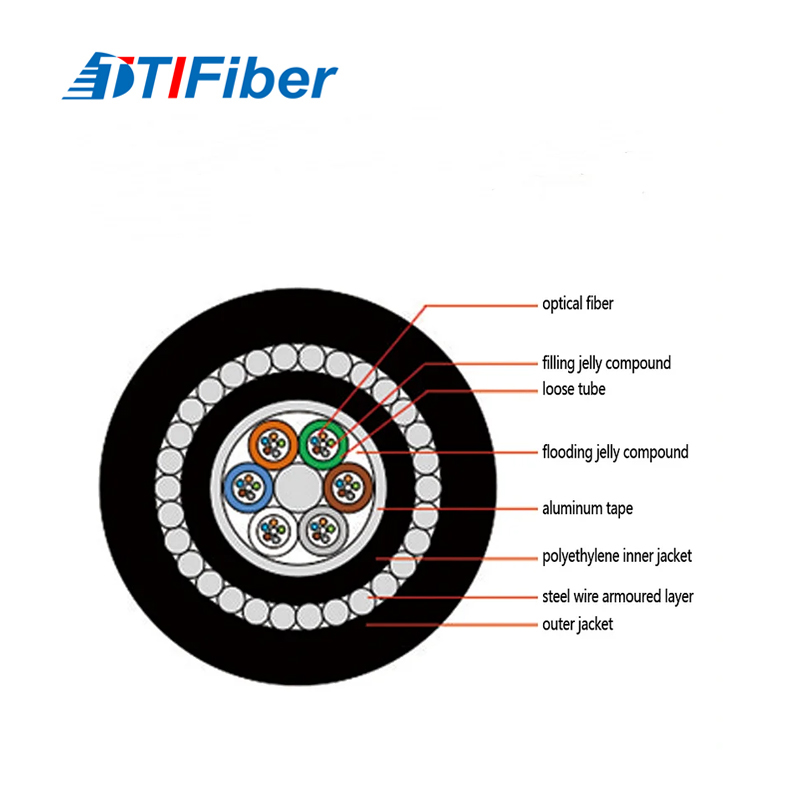
Armored cable, by contrast, incorporates a metallic sheath—typically corrugated aluminum or smooth stainless steel—that resists radial compression and puncture. This armor:
- Prevents fiber breakage during installation when rocks or shovels strike the cable.
- Shields against long-term soil pressure that could induce microbending losses.
- Blocks penetration by burrowing animals or invasive roots.
Moreover, many direct-burial armored cables include water-blocking gel or dry swellable tapes, and the metal layer itself acts as a moisture barrier. Combined, these features ensure signal integrity even in flooded trenches or high-water-table regions. For utilities and municipalities laying miles of rural broadband, armored direct-burial cable reduces lifetime maintenance costs by eliminating the need for conduit—a significant savings in both material and labor.
Why Do Industrial and Manufacturing Facilities Rely on Armored Fiber?
Inside factories, refineries, power plants, and warehouses, fiber runs alongside machinery, forklifts, conveyor belts, and maintenance crews wielding sharp tools. Here, the threat isn’t environmental—it’s mechanical aggression.
An unarmored patch cord dangling near a robotic arm might be sliced in seconds. A backbone cable routed along a catwalk could be crushed by a dropped wrench. In such settings, armored fiber provides impact resistance and cut protection that standard cables simply can’t match.
Common choices include:
- Stainless steel interlock armor for chemical resistance in oil & gas facilities.
- Aluminum-armored riser cables (OFNR) for vertical runs between floors, meeting fire codes while resisting damage.
- Tight-buffered armored cables with ruggedized jackets for machine-to-machine connections in automation cells.
Critically, armored industrial fiber often integrates EMI/RFI shielding—not because fiber is affected by electromagnetic interference (it isn’t), but because metallic armor protects any accompanying copper conductors (e.g., in hybrid power+data cables) and prevents the cable from acting as an antenna for induced surges.
In industries where downtime costs thousands per minute, the modest premium for armored cable is trivial compared to the risk of a single unplanned outage.
Why Are Armored Cables Essential in Rodent-Prone or Rural Areas?
Rodents—rats, mice, gophers, even squirrels—have a notorious habit of chewing through fiber cables. Their incisors grow continuously, and they gnaw on hard objects to wear them down. Plastic cable jackets, unfortunately, make excellent targets.
In agricultural zones, forests, deserts, and tropical regions, rodent damage accounts for a significant portion of unexplained fiber outages. Unarmored cables offer no resistance; armored cables do.
The corrugated aluminum or steel armor acts as a physical deterrent:
- Rodents cannot penetrate the metal layer with their teeth.
- Even if they try, the metallic taste and hardness discourage continued gnawing.
- Field studies show armored cables in rodent-heavy areas experience >70% fewer animal-related failures over five years.
For rural broadband deployments—especially government-funded FTTH projects in remote communities—specifying armored drop or distribution cable is often a non-negotiable requirement. The cost of dispatching a crew to repair a chewed line in a mountainous or swampy region far outweighs the upfront cable premium.
Why Are Armored Cables Used in Aerial Self-Supporting Applications?
Not all aerial fiber runs hang from messenger wires. In cost-sensitive or rapid-deployment scenarios, self-supporting armored cables integrate a strength member—often a steel messenger—directly into the cable structure, sometimes within or alongside the armor.
These designs, such as Figure-8 armored cables or all-dielectric self-supporting (ADSS) variants with metallic armor, allow:
- Spanning between poles without separate lashing hardware.
- Resistance to wind-induced vibration (aeolian vibration) that fatigues standard cables.
- Protection against accidental contact from tree limbs, drones, or maintenance equipment.
The armor here serves dual roles: structural reinforcement and environmental shielding. In hurricane-prone or icy regions, this combination ensures the cable survives not just installation, but decades of weather extremes.
Why Do Military, Government, and Secure Facilities Specify Armored Fiber?
In defense, intelligence, and critical infrastructure applications, security extends beyond encryption—it includes physical tamper resistance.
Armored fiber cables are specified because they:
- Resist cutting or splicing attempts by unauthorized personnel.
- Can be integrated with fiber-optic intrusion detection systems (FOIDS) that sense micro-vibrations from tampering.
- Withstand blast overpressure, shrapnel, and vehicle run-over in battlefield or perimeter scenarios.
Stainless steel armor is common here, often paired with hermetically sealed fibers and EMI-hardened jackets. These cables may also meet stringent standards like MIL-DTL-83526 or NATO STANAG, ensuring performance under extreme duress.
For these users, armor isn’t about convenience—it’s about mission assurance.
Why Might Armored Cable Be Used Indoors—Despite the Added Complexity?
While rare, armored cable does appear in indoor settings when risk outweighs handling difficulty:
- Riser applications: In multi-story buildings, OFNR-rated armored cables prevent flame spread while resisting damage during construction or future retrofits.
- High-traffic corridors: Hospitals, airports, and campuses sometimes use armored cable in exposed pathways where carts, luggage, or cleaning equipment pose impact risks.
- Historic or inaccessible walls: When pulling new fiber through century-old conduits with unknown obstructions, armor provides insurance against snagging or abrasion.
Even here, installers must manage grounding (for metallic armor) and larger bend radii—but the trade-off is justified by long-term reliability in hard-to-access locations.
Is Armor About Over-Engineering—or Intelligent Risk Management?
Armored fiber isn’t used because engineers enjoy complexity. It’s deployed because some environments don’t forgive compromise.
Every application above shares a common thread: the cost of failure—whether financial, operational, or strategic—dwarfs the incremental expense of armor. In these contexts, armored cable isn’t “overbuilt.” It’s appropriately defended.
And that’s the essence of professional engineering: not adding protection everywhere, but placing it exactly where the world demands it. Because in the silent journey of light through glass, sometimes the best guardian is a layer of steel.


Why Would Anyone Use a Cable Without Armor
ADSS and OPGW: The Complete Engineering Comparison
Related Article