Why Would Anyone Use a Cable Without Armor
What Is Unarmored Fiber Optic Cable?
In the world of fiber optic deployment—whether threading through data center racks, rising in building risers, or spanning city streets—the choice of cable construction is never arbitrary. Among the most fundamental distinctions is whether a cable is armored or unarmored. While armored variants grab attention for their ruggedness, unarmored fiber optic cable quietly powers the vast majority of optical networks worldwide.
But what exactly defines an unarmored cable? Where is it appropriate—and where is it dangerously inadequate? And why do engineers choose it despite its apparent vulnerability?
Let’s explore unarmored fiber not as a “lesser” option, but as a purpose-built solution shaped by physics, economics, and intelligent risk management.
What Does “Unarmored” Actually Mean in Fiber Optic Cables?
“Unarmored” refers to fiber optic cables that lack a metallic or interlocking protective layer designed to resist crushing, rodent bites, or physical penetration. Instead, they rely on dielectric (non-metallic) materials—such as polyethylene, PVC, LSZH (Low Smoke Zero Halogen), or aramid yarn (e.g., Kevlar®)—for tensile strength and basic mechanical protection.
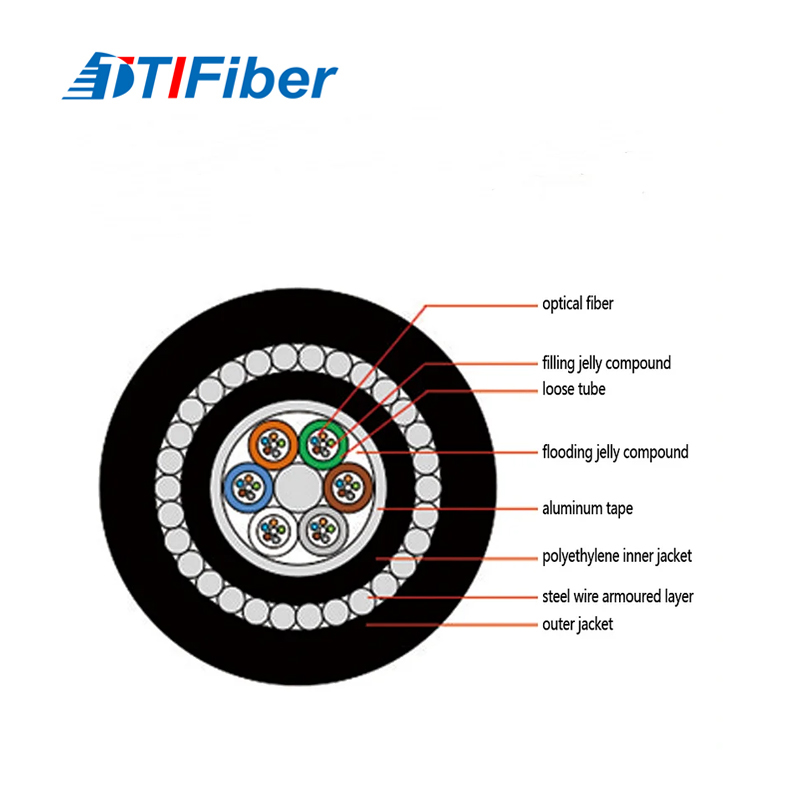
A typical unarmored cable structure includes:
- Optical fibers (single-mode or multimode), often buffered in 250 µm acrylate coating.
- Strength members: Usually aramid yarn or fiberglass rods, which absorb pulling tension during installation.
- Buffer tubes or ribbons: To organize and protect fiber groups.
- Outer jacket: Made of UV-resistant polyethylene (for outdoor use) or flame-retardant PVC/LSZH (for indoor/plenum spaces).
Crucially, there is no corrugated steel tape, aluminum interlock, or wire armor beneath the jacket. This absence reduces weight, cost, and diameter—but also removes a key defense against severe mechanical threats.
Why Would Anyone Use a Cable Without Armor—Isn’t That Risky?
Not if the environment doesn’t demand it. In fact, using armored cable where it’s unnecessary introduces drawbacks:
- Higher cost (up to 30–50% more per meter).
- Increased weight and stiffness, complicating pulling through conduits.
- Larger bend radius requirements.
- Potential grounding complications in metallic-armored types.
Unarmored cable is ideal for controlled, low-risk environments where physical damage is unlikely:
- Indoor horizontal runs (e.g., from telecom room to workstation).
- Data center interconnects between racks or zones.
- Conduit-protected outdoor links, where the conduit itself provides crush and rodent protection.
- Aerial installations using messenger-supported designs (e.g., ADSS—All-Dielectric Self-Supporting), where the cable’s own tensile elements handle span loads.
In these settings, unarmored cable isn’t “risky”—it’s optimized. It delivers performance, flexibility, and cost-efficiency without over-engineering.
How Does Unarmored Cable Protect Fibers Without Metal Armor?
While it lacks metal, unarmored cable employs layered passive protection:
- Primary Coating: Each fiber is coated with a soft 250 µm UV-cured acrylate layer that cushions microbends and absorbs stress.
- Buffer Tubes: Fibers are housed in loose tubes filled with water-blocking gel (outdoor) or dry water-swellable tapes (indoor), isolating them from external strain.
- Aramid Yarn Strength Members: These high-tensile synthetic fibers (like Kevlar®) run parallel to the fiber core, bearing all installation tension so the glass never stretches.
- Robust Outer Jacket: Formulated for specific environments—UV-stable for outdoor exposure, fire-retardant for indoor plenums, rodent-deterrent additives in some direct-burial variants.
Moreover, installation practices compensate for lack of armor: pulling eyes, proper bend radius control, and conduit use ensure fibers never experience damaging forces.
In essence, unarmored cable shifts protection from inherent ruggedness to intelligent deployment.
Can Unarmored Cable Be Buried Directly in the Ground?
Generally, no—not without additional protection. Standard unarmored cables lack the crush resistance needed to survive soil pressure, rock impingement, or backhoe strikes. Burying them directly risks:
- Microbending loss from point loads.
- Fiber breakage during thermal cycling or ground settlement.
- Water ingress if the jacket is compromised.
However, specialized unarmored direct-burial cables do exist. These feature:
- Thicker, abrasion-resistant jackets (often with HDPE).
- Central or peripheral water-swellable tapes instead of gel.
- Sometimes dual-jacket designs or corrugated polypropylene tape for added crush resistance—still non-metallic, thus “unarmored.”
Even then, best practice recommends installing them in conduit or at depths >36 inches with warning tape above. True direct-burial resilience usually requires armored cable (e.g., with corrugated steel tape).
What Are the Key Standards Governing Unarmored Fiber Cables?
Unarmored cables must comply with rigorous international and national standards that define performance, safety, and environmental resistance:
- IEC 60794: International standard for optical fiber cable characteristics (mechanical, thermal, environmental).
- ITU-T G.652/G.655: Defines fiber type compatibility (not cable, but critical for system design).
- Telcordia GR-20: North American reliability standard for outside plant (OSP) cables, including tensile load, temperature cycling, and water penetration tests.
- NEC (NFPA 70): Classifies indoor cables by fire rating:
- OFNR (Riser): Flame propagation resistance for vertical runs.
- OFNP (Plenum): Low smoke, zero halogen for air-handling spaces.
- EN 50173 / ISO/IEC 11801: Structured cabling standards for enterprise networks.
These ensure that even “unarmored” cables meet minimum durability thresholds for their intended use—proving that protection isn’t just about metal.
How Does Unarmored Cable Compare to Armored in Real-World Applications?
| Factor | Unarmored Cable | Armored Cable |
|---|---|---|
| Cost | Lower (20–40% less) | Higher |
| Weight | Lighter, easier to pull | Heavier, stiffer |
| Diameter | Smaller, fits tighter conduits | Larger |
| Installation Speed | Faster (no grounding, flexible) | Slower (requires armor termination) |
| Crush Resistance | Moderate (relies on conduit) | High (self-protecting) |
| Rodent Resistance | Low (unless specially jacketed) | High (metal barrier) |
| Typical Use Cases | Data centers, indoor LANs, conduit-protected OSP | Direct burial, industrial plants, exposed outdoor runs |
The choice isn’t about superiority—it’s about matching threat level to protection level. Using armored cable in a data center is like wearing a bulletproof vest to a board meeting: safe, but unnecessarily cumbersome.
Are There Hidden Advantages to Choosing Unarmored Cable?
Yes—beyond cost and flexibility:
- Dielectric Nature: No metal means no lightning attraction and no grounding requirements. This simplifies installation near power lines or in lightning-prone areas.
- EMI Immunity Reinforced: While all fiber is immune to EMI, unarmored dielectric cables eliminate even theoretical coupling paths through metallic sheaths.
- Easier Splicing and Termination: No armor to strip, ground, or seal—reducing technician time and error risk.
- Environmental Compatibility: Non-metallic construction avoids galvanic corrosion in coastal or chemically aggressive soils.
In sensitive applications—like hospitals, research labs, or explosive environments—these traits make unarmored cable not just acceptable, but preferred.
So—When Should You Absolutely Avoid Unarmored Cable?
Avoid unarmored cable in any scenario with unmitigated physical hazards:
- Direct burial without conduit.
- Exposed outdoor runs vulnerable to vandalism or wildlife.
- Industrial settings with heavy machinery, forklift traffic, or sharp debris.
- Areas with known rodent infestations (unless using rodent-resistant jacket variants).
- Long aerial spans without messenger support (use ADSS or lashed designs instead).
In these cases, the modest upfront savings of unarmored cable can lead to catastrophic failures, costly outages, and repeated repairs—a false economy.
Is “Unarmored” a Weakness—or a Sign of Smart Engineering?
Unarmored fiber optic cable embodies a core engineering principle: optimize, don’t overbuild. It acknowledges that protection comes not only from the cable itself, but from the system around it—conduits, pathways, installation discipline, and environmental assessment.
In the right context, unarmored cable delivers flawless performance with elegance and efficiency. It’s not “unprotected”—it’s appropriately protected.
And in a world racing to deploy fiber faster, cheaper, and smarter, that distinction isn’t just technical—it’s strategic.


The Core Structural Layers of an Unarmored Fiber Optic Cable
Why Is Armored Cable Preferred for Direct Burial Installations
Related Article